Utopia
Eight years before SimCity, a Mattel programmer gave Intellivision owners the chance to govern a struggling island nation in real time — and accidentally seeded the simulation and real-time strategy genres at once.

Utopia is a strategy and simulation video game designed and programmed by Don Daglow and published by Mattel Electronics for the Intellivision, released in 1982.69 The game placed each of one or two players in charge of an island nation, tasking them with managing resources, populations, and every aspect of government from agriculture to the military through a turn-based but timed interface.5 It is widely cited as one of the earliest city-building and simulation games and has been called “arguably the earliest ancestor of the real-time strategy genre”.1
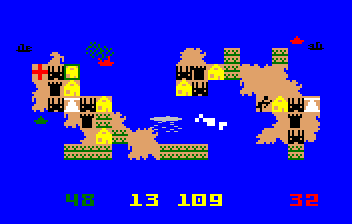
The objective is to build a thriving society — a utopia — measured by the collective well-being of the populace under the player’s rule and expressed as a point score influenced by such factors as security, housing, and food production.5 Two players could compete, each controlling a separate island, or a single player could attempt to beat a personal best by raising the satisfaction of the populace.5 The 1982 catalog described the choice open to each ruler as being between a benevolent ruler and an aggressive dictator, with points accumulated according to the welfare of the island people.6 One or two could play, either competitively or cooperatively.6
Gold bars finance the island’s development, funding construction and agriculture projects, fishing boats, and military endeavors; each turn yields a fixed income that can be increased through wise investment in infrastructure.5 Factories serve as the major source of income, providing a large boost each round they operate, but they require workers, which in turn demands a larger population whose needs for food, shelter, education, and health care drive the player to plant crops, buy fishing boats, and build schools, housing developments, and hospitals.5 Things grow expensive quickly, leaving the player perpetually short of both time and money for everything that needs doing.10
Players move a box-shaped cursor around the screen to issue construction commands and reposition boats, the game running in real time so that life on and between the islands continues unabated through every moment of indecision.91 Fishing boats provide food and income and are among the few resources under the player’s direct control, allowing the player to search out schools of fish to land a rich catch; the surrounding seas, however, hold pirate vessels, tropical storms, hurricanes, and enemy PT boats, any of which can sink a boat and force a 25-gold-bar replacement.5 Building PT boats of one’s own protects the fishing fleet from enemy vessels, while avoiding storms is largely a matter of luck.5
A further danger comes from rebellious factions that arise when the player fails to provide adequate food and welfare for a growing populace; rebels may also be funded by the opposing player, and they destroy factories and hospitals unless the player invests in a defensive fort.5 Uprisings can be quelled only through defensive and infrastructure investments that raise the well-being of the people, and a player could in turn fund rebels on an opponent’s island in revenge.5 A random weather model can produce a bumper crop just as easily as it destroys one, and the appearance of a hurricane could wipe out crops, sink the fishing fleet, and destroy homes and factories.106
Reviewers noted that, unlike later simulations in which neglect alone causes decay, Utopia pitted players against an opponent who would actively infiltrate and destroy their island paradise — sending rebels or maneuvering PT boats to let pirates through.10 Players could also form alliances and attempt to cooperate, a dynamic made tense by the knowledge that the other player might break the treaty at the worst possible moment.10 One retrospective emphasized the depth of the game’s chains of consequence: building a hospital improved citizens’ lives but ballooned the population, which diluted the efficacy of other structures and meant more mouths to feed, so that the choice between investing in the military and sinking money into infrastructure was always a difficult one.10
Development and release
Don Daglow had been a fan of mainframe computer simulation games in college, and Utopia grew naturally from his wish to attempt a simulation game on the Intellivision.6 It was released as Mattel Electronics cartridge #5149, the company’s release number 33, on June 3, 1982, under the working title “Island”.6 Daglow handled both design and programming, with graphics by Kai Tran and Daglow, sound by Russ Lieblich, and package illustration by Jerrol Richardson.69
Although Mattel’s marketing department put little push behind the game, preferring graphically splashier, simpler titles such as Star Strike, favorable reviews — including a place in Playboy magazine’s “Video Game Hall of Fame” — and word of mouth pushed sales to a respectable 250,000 copies.6 Contemporaries praised the game for its originality, noting that it was neither an arcade rip-off nor a video adaptation of an existing game or sport, and that it was educational without being boring.6
Critics observed that the Intellivision was the only console of the era with both the processing power for the game’s many variables and a hand controller whose multi-button keypad — used with a printed overlay — put resource management literally at the player’s fingertips, a design difficult to imagine on a single-button controller such as the Atari 2600’s.5 A version for Mattel’s Aquarius computer was also released.69 The game was later re-released on later platforms, and the Intellivision and Aquarius versions both appear in the reference book 1001 Video Games You Must Play Before You Die.9
Legacy
Utopia is among the best-remembered Intellivision games and is frequently referred to as “Civilization 0.5,” “Civilization .5,” or “Civ 0.5,” a reference to Sid Meier’s later breakthrough simulation game.610 Retrospective writers credit it with laying the groundwork for simulation classics such as Civilization and SimCity, the latter of which appeared some eight years after Utopia.95 One assessment held that in some respects Utopia had a more complex design than its modern successors, since its competitors actively worked to destroy the player’s nation rather than allowing it merely to decay through neglect.10
As a forerunner of real-time strategy, Utopia introduced the combination of base building, resource management, and semi-autonomous combat conducted in real time rather than turn by turn — a fusion of the deliberate strategy game with the speed of action play that was, at the time, considered the antithesis of strategy.1 According to one history of the genre, Daglow’s game required the player not only to infiltrate or destroy an opponent’s attempted utopia but also to build a happy and thriving home base, weighing infrastructure, manufacturing, military, weather patterns, spies, and pirates, all while pirate raids, hurricanes, wilting crops, and rebel uprisings proceeded without pause.1
The game stood at the head of a lineage of “action-strategy” experiments that followed, the next of note being Dan Bunten’s Cytron Masters (1982), with the broader chain running toward the modern real-time strategy form.1 Later critics suggested that design ideas in such management games as Tropico and Republic sound as though they were inspired by the Utopia instruction manual.10
Sources
History of real-time strategy games from their origins through the 1990s-2000s, examining the genre's rise and influence.
arstechnica.com · retrieved Jun 29, 2026GameSpy retrospective on Utopia, an early 1981 Intellivision simulation game allowing players to build island nations.
gamespy.com · retrieved Jun 29, 2026Production history and details of Utopia, the 1982 Intellivision simulation game designed by Don Daglow.
history.blueskyrangers.com · retrieved Jun 29, 2026MobyGames database entry describing Utopia gameplay mechanics and noting its foundation for later strategy games.
mobygames.com · retrieved Jun 29, 2026Archive article identifying Utopia as an unsung hero that influenced modern simulation games like Civilization and SimCity.
web.archive.org · retrieved Jun 29, 2026