The Legend of Zelda
The gold-cartridge NES adventure that sent a green-clad swordsman across a sprawling, dungeon-riddled overworld and laid down a formula Nintendo would reuse for nearly forty years.
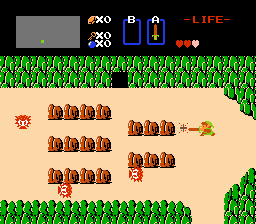
The Legend of Zelda is an action-adventure video game developed and published by for the and the , the first entry in what became one of the most enduring series in the medium.25 It was directed by and Takashi Tezuka and developed by Nintendo’s Entertainment Analysis and Development division.54 The game was first released in Japan as Zelda no Densetsu: The Hyrule Fantasy on February 21, 1986, reaching North America on August 22, 1987, and Europe on November 15, 1987.52
The game casts the player as Link, a swordsman who sets out to rescue Princess Zelda from Ganon, the King of Evil, who has broken free from the Dark World and captured her.2 Before her capture, Zelda shattered the Triforce of Wisdom and scattered its eight pieces throughout the kingdom of Hyrule; Link must recover all eight, navigate the realm’s dungeons, and defeat Ganon to free her.2 Reviewers and tracking sites classify it as a top-down action-adventure with open-world elements, and completion times average roughly eight to nine hours, with the main story polling around eight hours and a completionist run nearer nine and a half.2 Tracking data also records its strong reception among players, with an aggregate rating of about 75 percent and an unusually low retirement rate of 4.6 percent — the share of players who abandon it unfinished.2
Design and development
According to the Zelda Wiki, the game began as a two-player dungeon creator before becoming a single-player adventure with underground dungeons surrounding Death Mountain, set among forests and lakes.7 Miyamoto has stated that his primary inspiration for the character and the flow of the game came from his childhood explorations of the hillsides and caves near his home in Japan.9 A persistent claim that Ridley Scott’s 1985 film Legend inspired the game is disputed; observers note the two were released at roughly the same time, and Miyamoto has attributed the concept to his own travels through caves rather than to the film.10 Some have suggested the movie’s influence may instead have surfaced in later entries such as The Legend of Zelda II: The Adventure of Link and A Link to the Past.10
was the same designer responsible for , having begun his career at Nintendo in 1977 and risen to general manager of the company’s Entertainment Analysis and Development division, where he has worked on numerous titles including Excitebike.4 The name Zelda was taken from Zelda Fitzgerald, wife of the author F. Scott Fitzgerald, whom the F. Scott Fitzgerald Society describes as an artist and writer who helped establish the “Roaring Twenties” image of liberated womanhood; Miyamoto admired the name and kept it.4 Link’s appearance — long hat and pointed, elf-like ears — drew on Miyamoto’s fondness for Disney and, in a 2012 interview, on the character of Peter Pan, while the graphical limitations of the NES encouraged the use of distinct shapes and silhouettes; the same constraint, Miyamoto has noted, is why Mario was given a mustache, so that his nose would read clearly in blocky graphics.4 The theme music was composed by Koji Kondo, who had initially wanted to use Ravel’s Boléro; because the piece remained under copyright, he wrote an original theme instead, perhaps lightly inspired by the Ravel work.4 Cross-references between Nintendo’s two flagship series proliferated as a result of their shared authorship: Yoshi appears as a prize in the Link’s Awakening remake, pictures of Mario, Luigi, and Bowser hang in Hyrule Castle in Ocarina of Time, and the warp-whistle tune is shared with Super Mario Bros. 3.4
Gameplay and structure
The game established the overworld-and-dungeon structure that later entries would inherit, presenting distinct regions such as lakes, deserts, graveyards, coastlines, forests, mountains, and rivers, with the notable absence of any town.5 Each dungeon supplied a map, a compass, key items, and a boss guarding a fragment of the Triforce, a template the series would reuse for decades.5 Progress is gated by equipment found within: the bow turns up in the first labyrinth, the raft is hidden in the third, and the ladder — needed to reach the boss of the fifth — lies in the second or fourth, so dungeons cannot be tackled in a strictly free order.35 Hidden bombable walls, often without visible cracks, force the player to deduce passages where no obvious route exists.3
Many recurring enemies debuted here, among them Octoroks, Moblins, Zoras, Tektites, Wizzrobes, Darknuts, and the skeletal Stalfos, the last reputed to appear in every subsequent game.54 The reviewer at Indie Gamer Chick observed that the open, non-linear feel of the original is closer to the modern than to the more tightly designed games between them, noting that the centaur-like characters of that later game trace back to this one.5 Combat is widely held to be the source of the game’s difficulty, as most dungeon rooms function as enemy challenges in which the player can be swarmed and cornered from all sides.3
The final confrontation with Ganon, who turns invisible and teleports about the room, must be struck repeatedly with the magic sword before being finished with a silver arrow hidden within the last dungeon, and has been singled out as among the weaker boss encounters Nintendo produced.5 The game offers a “first quest” and a tougher “second quest” that rearranges its dungeons and enemy placements.5 The reviewer at Indie Gamer Chick praised Ganon as a villain despite the design of his fight, ranking the monstrous Ganon above his later human form, Ganondorf.5
Release and legacy
The Legend of Zelda was one of the few NES titles to ship in a gold cartridge, a distinction it shared with its sequel; the gold cart is in fact more common than the grey version, which collectors prize more highly.4 Original gold cartridges remain sought after, with listed examples on the secondary market reaching several hundred dollars.1 The game has since been reissued across many platforms, including Game Boy Advance, the Game & Watch line, and Nintendo Switch through the Switch Online service, and emulated versions extend to later hardware up to Nintendo Switch 2; a special Switch Online edition subtitled “Living the Life of Luxury” supplies the player with maxed-out upgrades to ease the experience.23
Within the franchise’s internal chronology, which splits after Ocarina of Time, The Legend of Zelda is placed late — in the “Era of Decline,” in the branch where Link is defeated by Ganon, following the “Era of Light and Dark” and the “Golden Era,” with The Adventure of Link immediately after it — despite being the first game made.4 The title became a fixture of “greatest games” lists and a World Video Game Hall of Fame inductee, and remains a staple of the speedrunning community, where the player lackattack24 of the United States set a recorded world-record completion of 27 minutes and 40 seconds.24 The series Miyamoto launched here went on to produce milestone entries such as Breath of the Wild, which was itself first prototyped as an 8-bit proof of concept resembling the original game.4
Sources
eBay marketplace listing for 1987 The Legend of Zelda NES video game cartridges and related merchandise.
ebay.com · retrieved Jun 29, 2026HowLongToBeat database entry tracking average playtime and completion statistics for The Legend of Zelda.
howlongtobeat.com · retrieved Jun 29, 2026YouTube video game review of the original NES Legend of Zelda with detailed gameplay commentary and scoring analysis.
youtube.com · retrieved Jun 29, 2026ESPN article featuring nine lesser-known facts about The Legend of Zelda series and its creator Shigeru Miyamoto.
espn.com · retrieved Jun 29, 2026Indie Gamer Chick retro gaming review of the original 1986 NES Legend of Zelda with historical context and critical analysis.
indiegamerchick.com · retrieved Jun 29, 2026Zelda Fandom Wiki article documenting the development history and game mechanics of the original Legend of Zelda.
zelda.fandom.com · retrieved Jun 29, 2026Today I Found Out article explaining Shigeru Miyamoto's inspirations for creating The Legend of Zelda game.
todayifoundout.com · retrieved Jun 29, 2026Zelda Universe forum discussion debating whether the film Legend influenced Shigeru Miyamoto's creation of the Zelda game.
zeldauniverse.net · retrieved Jun 29, 2026