Super Mario Kart
Nintendo’s answer to the question of what a two-player racing game might look like with a plumber behind the wheel, it invented the kart-racing genre almost by accident.

Super Mario Kart is a 1992 kart racing game developed and published by Nintendo for the Super Nintendo Entertainment System, the first entry in the Mario Kart series.13 It was released in Japan on August 27, 1992, in the United States on September 1, 1992, and in the United Kingdom and Europe on January 21, 1993.9 Widely credited with establishing the kart-racing subgenre, the game placed inhabitants of the Mushroom Kingdom in go-karts and paired split-screen multiplayer racing with an arena-style battle mode.1012 It became one of the best-selling games on the SNES and the foundation of a franchise whose combined sales have since exceeded 150 million copies.713
Origins and development
Super Mario Kart grew directly out of Nintendo’s earlier SNES racer F-Zero, which was released for the console but was exclusively single-player.13 Following that game’s Japanese launch, Nintendo developers set out to build a two-player racing game as a follow-up.1324 The game was originally conceived as a two-player version of F-Zero, but the limitations of the hardware required a different approach.24 The team built a prototype featuring a generic “guy in overalls,” and decided to incorporate Super Mario characters and concepts after adding Mario driving one of the karts out of curiosity about how the game would look, and being satisfied with the result.13 The game was not originally intended to be part of the Super Mario series.22
The series is also considered to trace its spiritual origins to the Japan-only Famicom Grand Prix games for the Family Computer Disk System, the first Nintendo racing games to feature Mario as a player character.13 Before Super Mario Kart, kart racing had appeared only in single-player arcade games; it was the first mainstream title to focus on the format.22
The game was directed by Hideki Konno and Tadashi Sugiyama, with development overseen by Shigeru Miyamoto, then general manager of Nintendo’s EAD division.133 Konno’s previous work had been as map director on Super Mario World, and Sugiyama had directed the SNES title Pilotwings, whose Mode 7 experience informed how the courses scroll, scale, and rotate.3 In researching the project, Konno read books on kart racing and the team spent a day go-kart racing at a local amusement park.23 Music was composed by Soya Oka and Taro Bando, whose work links back to the sounds of Super Mario World and Pilotwings; Bando would later score Stunt Race FX.3

Technology and design
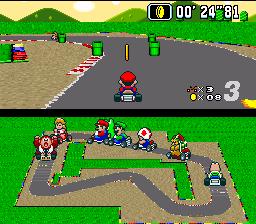
The game shipped on a modest 4-megabit cartridge — roughly half a megabyte — and relied on the SNES’s Mode 7 graphics mode to rotate, scale, and scroll the flat race courses beneath the player’s kart.310 The tracks themselves consisted of giant, square-shaped fields that rotated and panned underneath the player’s wheels, with obstacles rendered as two-dimensional sprites standing perpendicular to the course.4 A digital signal processor (DSP) chip included on the cartridge acted as an extra maths co-processor and was instrumental in enabling the two-player competitive racing that reviewers of the day praised most highly.3 The first issue of the U.K. magazine Super Play awarded the game 93% in November 1992, singling out the DSP chip’s hardware assistance.3 Because split-screen occupied only the upper half of the display, single-player racing filled the lower half with either a rear-view mirror or a course map marking rivals’ positions.3 A Nintendo advertisement in Europe promised players that awaiting the SNES rather than a SEGA Mega Drive would be “worth its wait in gold. (And 32,767 other colours)”.3
The eight playable characters — Mario, Luigi, Princess Toadstool, Toad, Yoshi, Bowser, Wario, and Donkey Kong Jr. — were each drawn as sprites in sixteen angles to allow full kart rotation, and were divided into distinct weight classes with individual battle techniques.4105 The lightweights, Yoshi, Peach, and Toad, accelerated quickly but had a low top speed and were easily knocked around, while heavier characters such as Bowser and Donkey Kong were slow off the line but could push others aside, with Mario and Luigi balanced between the extremes.5 The single-player Mario GP mode ran across twenty tracks spread over four cups, with five laps per race and five tracks per cup, at three engine-size difficulty levels of 50cc, 100cc, and 150cc.35
Courses drew on the environments of Super Mario World’s Dinosaur Land, from Donut Plains and Ghost Valley to Koopa Beach, Choco Island, and Bowser Castle.3 Track surfaces varied in texture between smooth road, wood, and gravel, and were littered with obstacles such as pipes, oil spills, deep water, lava, and ice blocks.310 Coins scattered across the tracks raised a kart’s top speed, and a racer who dropped to zero coins became vulnerable to being spun out by opponents.23 Items dispensed from question-mark blocks included the boost mushroom, green and homing red turtle shells, and banana peels.513 The controls demanded that players master the timing of a shoulder-button hop, which set the kart into a skid for cutting a tight hairpin without decelerating on grit or rough surfaces.3
Reception and legacy
Contemporary and retrospective reviewers regarded the game as one of the most influential titles of the 16-bit era, with its two-player battle mode — in which each kart carried three balloons to be defended and popped — frequently called its most addictive feature.1012 GameSpy wrote that the kart-racing subgenre “didn’t even exist” before Super Mario Kart, and that no later clone matched the original’s balance and charm.12 The AllGame reviewer Brett Alan Weiss called it “one of the best, most influential games ever created for a 16-bit system,” awarding it a high rating and noting that it “finishes in front of the pack every time” against its many imitators.10 IGN ranked it among its top 100 games, noting that it arrived well before any rival kart racer and defined the genre with “wacky tracks, wacky characters, wacky weapons, and multiplayer”.7 According to IGN, the game sold eight million copies, making it at the time the third-best-selling SNES title 7; players continued to compete in its Time Trial mode long after release, with many preferring it to newer entries.7
The game established conventions carried through the entire Mario Kart series.13 Its cups, weight classes, coins, and item-box weaponry recur in later entries, and its Battle Course 1 reappears as a battle stage as recently as Mario Kart 8 Deluxe.17 Its success prompted numerous cartoon-style kart racers from other publishers from the 16-bit generation onward, imitators such as South Park Rally among them.1310 Reviewers noted that even as companies tried to “sideswipe it,” Mario Kart remained “a world apart,” and that it “pretty much defined the genre” with little done to redefine it since.2
The direct successors Mario Kart 64 on the Nintendo 64 and Mario Kart Super Circuit on the Game Boy Advance both built on its formula, with Super Circuit functioning largely as a remake that let players unlock the original SNES tracks.952 Because the Game Boy Advance ran on hardware essentially the same as the SNES, Super Circuit looked, sounded, and played much like the original, reusing many of its sound effects.5 The line continues through Mario Kart World, the 2025 Nintendo Switch 2 launch title whose critics still measure new entries against “the first edition in 1992”.1320
Super Mario Kart was later reissued on the Wii’s Virtual Console in 2009, the Wii U’s Virtual Console in 2013, and the New Nintendo 3DS Virtual Console, and was included among the games of the Super NES Classic Edition.910 Nintendo released the 60Hz US version on the European Wii U eShop in 2014, giving PAL players a full-screen, border-free presentation of the game for the first time.9
Sources
Review of Mario Kart Super Circuit for Game Boy Advance, comparing it to the original Super Mario Kart and other kart racers.
eurogamer.net · retrieved Jul 3, 2026Review of the original Super Mario Kart for SNES, discussing its Mode 7 graphics, multiplayer capabilities, and lasting impact on the racing genre.
nintendolife.com · retrieved Jul 3, 2026Review of Super Mario Kart for SNES covering gameplay mechanics, graphics, audio, and controls from a retrospective perspective.
web.archive.org · retrieved Jul 3, 2026GameSpot review of Mario Kart Super Circuit for Game Boy Advance, evaluating it as a remake of the original SNES game.
web.archive.org · retrieved Jul 3, 2026IGN's entry on Super Mario Kart in a top 100 games list, highlighting its influence on the racing genre and sales success.
web.archive.org · retrieved Jul 3, 2026Nintendo Life review of Super Mario Kart on Wii U eShop, discussing its technical achievements and multiplayer design for the SNES.
web.archive.org · retrieved Jul 3, 2026AllGame overview of Super Mario Kart for SNES, describing it as one of the most influential 16-bit games with character-specific techniques and power-ups.
web.archive.org · retrieved Jul 3, 2026GameSpy's description of Super Mario Kart as a pioneering SNES title that created the kart-racing sub-genre with balanced gameplay and addictive battle mode.
web.archive.org · retrieved Jul 3, 2026Mario Wiki article on the Mario Kart series, documenting its history, development, gameplay features, and franchise success across Nintendo platforms.
mariowiki.com · retrieved Jul 3, 2026Official Nintendo page for Mario Kart 8 Deluxe on Switch, detailing game features, roster, tracks, battle modes, and DLC content.
mariokart8.nintendo.com · retrieved Jul 3, 2026Metacritic page for Mario Kart World on Nintendo Switch 2, aggregating critic and user reviews of the latest mainline entry.
metacritic.com · retrieved Jul 3, 2026GameGrin article celebrating Super Mario Kart's history as the first mainstream karting game and its influence on the gaming industry.
gamegrin.com · retrieved Jul 3, 2026Teechu article exploring the origins and creation of Mario Kart, including Mode 7 technology and the development team's research process.
teechu.com · retrieved Jul 3, 2026HyperX Arena article about Super Mario Kart's development by Tadashi Sugiyama and Hideki Konno, originally conceived as a two-player F-Zero variant.
hyperxarenalasvegas.com · retrieved Jul 3, 2026