Space Panic
A shovel-wielding astronaut trapping man-eating aliens in dug pits, in the 1980 arcade oddity now widely credited as the first platform game.
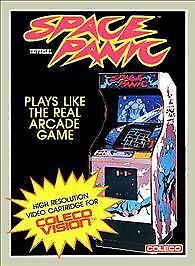
Space Panic is a 1980 arcade video game developed and published by the Tokyo-based manufacturer Universal, in which the player controls an astronaut who digs holes in girder platforms to trap and eliminate pursuing alien monsters.1710 Presented in side view and released in North America in 1980 by Universal U.S.A. of Santa Clara, California, it is often cited as the first platform game.1413 The game is played from a fixed, flip-screen perspective in a science-fiction setting.17 Some accounts date its North American debut to December 20, 1980.16
Universal was a prolific coin-op producer that released 53 machines under its trade name from 1977 onward, among them Cosmic Guerilla, Cosmic Alien, and Devil Zone.10 According to Universal producer Hideyuki Yokoyama, the company’s software development department in its earliest days consisted of just two people, working from two-page planning documents, without sprite editors or sound tools, and composing music on a Casiotone keyboard before transcribing it into the game.6 Designer Kazutoshi Ueda recalled that Space Panic was one of the earliest projects he worked on at Universal, alongside colleagues who went on to form a developer in the Kansai region.6

The player maneuvers a spaceman up and down ladders and across a series of horizontal girders while avoiding alien creatures.182 Rather than shooting, the spaceman digs holes in the girders to trap monsters, then fills the holes back in to drop the trapped creatures through the floors below and kill them.1713 Some monsters must fall through two or three floors before they die, requiring the player to dig multiple holes aligned vertically; on higher levels the player must dig two perfectly placed holes, one above the other, to keep an alien confined.218 Dropping one creature onto another eliminates both and awards bonus points, and clearing a screen of all monsters advances the player to the next stage.217
A bonus timer representing the astronaut’s oxygen supply counts down continuously; if it reaches zero, the spaceman asphyxiates and dies, and clearing a level of aliens replenishes the oxygen tank.216 The monsters are ranked by color and toughness — variously described across sources as red Creatures, blue Dons, and green Bosses — with tougher enemies surviving longer falls; a trapped monster that breaks loose escalates to a stronger form.1321 Scoring rises with the number of floors a monster falls through.18 The KLOV database classifies the machine under the labyrinth/maze genre and lists it as a single-player game — supporting a maximum of two players in alternating play — with a four-way joystick and two buttons for digging and filling, produced in cocktail, cabaret/mini, and upright cabinet forms with a vertical raster monitor.10 The published high score recorded in that database is 58,090, achieved by Todd Havlik.18
Lineage and influences
According to Codex Gamicus, the premise of digging holes to trap aliens was likely inspired by the contemporary Heiankyo Alien, a 1979 game.22 TV Tropes similarly notes that although Space Panic takes place in side view, its mechanics — which do not include jumping — are in some ways closer to maze games, particularly Heiankyo Alien.13
Space Panic predates the ladders-and-levels form popularized by Donkey Kong, which arrived a year later; commentators describe it as “the first game with levels and ladders,” ahead of both Donkey Kong and Nichibutsu’s Crazy Climber, also released in 1980.16 Reviewers have also emphasized its status as the first arcade game in which success depends on climbing ladders.16
The game proved influential enough to spawn a wave of clones and descendants. It is frequently credited with inspiring Brøderbund’s Apple Panic and, later in the decade, Lode Runner, both of which adapted its digging-and-trapping mechanic for home computers.162 Universal itself reused the concept in Mr. Do!’s Castle.13 Other clones catalogued for home systems include Digger Barnes by Cable Software for the Amstrad CPC, Digger Dan and Panic for the ZX Spectrum, Monsters by Acornsoft for the BBC Micro, Monster Inn by Tomy for the Tomy Pyuuta, and Color Panic by Tom D. and Brett N. Keeton, published by Spectral Associates for the Radio Shack Color Computer in late 1983.134 In Color Panic, escaped monsters mutate into more powerful shapes that must be reverted through multiple falls before they can be killed, mirroring the escalation of the original.4
Its reach extended to British 8-bit gaming through Chuckie Egg, the 1983 platform game by 15-year-old programmer Nigel Alderton at A&F Software.1 Alderton has said his favorite arcade game was Space Panic, which he played at an arcade near his bus station on his way home from a Saturday job, and that he “nicked all the bits out of Space Panic” that he liked, remarking that a screenshot of Space Panic placed beside Chuckie Egg would be “embarrassingly similar,” with identical colors.1
Ports and reception
Space Panic was not widely ported, but home conversions followed in 1983, including a version for the Casio PV-1000 and a ColecoVision release published by CBS Electronics.1714 The Dot Eaters describes the ColecoVision conversion as a faithful arcade translation.14
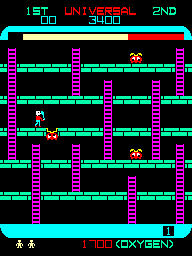
Reviewing the ColecoVision version for Digital Press, Kevin Oleniacz rated it 4 out of a possible score for graphics and gameplay and 6 for sound, describing it as a “one-dimensional climbing/digging contest” whose simple concept held interest only briefly and whose girder-heavy screens were not “visually eye-pleasing”.2 He judged that once the creatures speed up, previous strategy is abandoned and the player is reduced to isolating a spaceman between two holes and waiting, concluding that Coleco “should have let Space Panic rest in peace”.2 The KLOV/IAM user score stood at 3.59 out of five from four votes as of December 2003.18
The ColecoVision cartridge circulates on the secondhand market, offered for US$13.99 by the retailer Gametrog as of the site’s listing.21 The digitized arcade original is preserved and playable through the Internet Archive’s emulated collection.17
Sources
Guardian article on the creation of Chuckie Egg, the influential 1983 platform game programmed by teenager Nigel Alderton.
theguardian.com · retrieved Jul 7, 2026Digital Press review of Space Panic for ColecoVision, rating the climbing and digging platformer as a moderately creative but ultimately repetitive game.
digitpress.com · retrieved Jul 7, 2026Database entry for Color Panic, a Space Panic clone for Color Computer released by Spectral Associates in late 1983.
lcurtisboyle.com · retrieved Jul 7, 20261989 Gamest magazine feature with arcade designers discussing game development at Universal, including the creation of Space Panic.
shmuplations.com · retrieved Jul 7, 2026Arcade Museum technical specifications and gameplay details for the original 1980 Space Panic arcade cabinet by Universal.
arcade-museum.com · retrieved Jul 7, 2026TV Tropes article describing Space Panic as the first platform game and documenting its clones and gameplay mechanics.
tvtropes.org · retrieved Jul 7, 2026The Dot Eaters history of Space Panic as the first platform game, tracing its influence and home computer ports.
thedoteaters.com · retrieved Jul 7, 2026The Logbook retrospective of Space Panic as an innovative arcade game predating Donkey Kong in ladder-climbing mechanics.
thelogbook.com · retrieved Jul 7, 2026Internet Archive emulation entry for Space Panic with basic game description and technical metadata.
archive.org · retrieved Jul 7, 2026Arcade Museum detailed specifications, gameplay rules, and scoring information for Space Panic arcade machines.
arcade-museum.com · retrieved Jul 7, 2026GameTrog product listing for a physical copy of the Space Panic arcade game with gameplay description.
gametrog.com · retrieved Jul 7, 2026Gamicus wiki entry on Space Panic noting its hole-digging mechanic may have been inspired by Heiankyo Alien.
gamicus.fandom.com · retrieved Jul 7, 2026