Space Invaders II
The rarest of the Space Invaders offshoots, a Midway in-house cocktail machine that turned the alien shoot-out into a duel between two players.
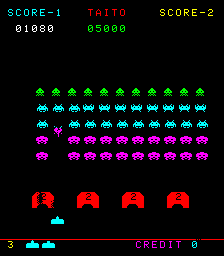
Space Invaders II is a 1980 arcade video game produced in-house by Midway Manufacturing Co. of the United States, adding a competitive two-player mode to the fixed-shooter formula established by Taito’s Space Invaders.5 Like the original, it requires the player to destroy waves of advancing invader ships descending from the top of the screen.5 Its distinguishing feature is a head-to-head mode in which two players fight to destroy one another in addition to fending off the marching attackers.5
The machine was housed in an early-1980s Midway cocktail cabinet with rounded corners and a small coin door, similar to that used for Galaxian.5 Its black glass top was screened with arrows pointing to “Space Invaders 2” at each side’s left corner, while the right corners carried the text “NEW two players play together”.5 The cabinet supported up to two simultaneous players and offered competitive play, controlled by a two-way joystick moving left and right and a single fire button per station.5 In the competitive mode, players could destroy the opposing ship — whether controlled by the second player or the CPU sweeping the playfield from above — and gain that ship.5 The game’s introduction instructed players to fend off the advancing invaders while remaining on guard for the second ship crossing the playfield from above.5
Technically the game ran on an 8080 CPU and belonged to Midway’s 8080 conversion class, with a vertically oriented standard-resolution raster monitor rendered in black and white with a color overlay.5 Sound was produced by a special two-channel mono sound system with separate sound boards.5 Midway credited the game as an in-house design; the programmer’s name was hidden in a small message inside one of the game’s PROMs.5 It was catalogued by the Museum of the Game as KLOV/MOG number 9668, classed as a wide release, and filed under the “Space” genre.5 Among the other Midway machines of the same period were Space Zap, Super Galaxians, Space Encounters, and Rally-X.5
Relation to Taito’s sequel
Space Invaders II is a distinct product from Taito’s own sequel, released in Japan and internationally as Space Invaders Part II (also 1980), a game that retained single-player and alternating two-player play and introduced invaders that split when shot, flying saucers dropping alien reinforcements, and an intermission sequence.71 Taito’s Space Invaders Part II was, according to the Museum of the Game, the first video game to include an intermission: at the end of each level the last invader flies off on a spaceship broadcasting an SOS, occasionally halted by “engine trouble”.7 It ran on a unique conversion class with a color monitor and was offered in both cocktail and upright cabinet styles.7
Taito’s sequel was released in America by Midway under the title Space Invaders Deluxe, a version that used a color overlay rather than a color monitor and differed chiefly in the point value of the blinking flying saucer — 500 points in Space Invaders Part II but only 200 in Space Invaders Deluxe.7 The American machine displayed the name Space Invaders Part II during its attract mode even though all its promotional material, manuals, service bulletins, motherboard labels, and cabinet tags carried the Space Invaders Deluxe name; the discrepancy is attributed to a licensing agreement between Taito and Midway that permitted only certain minor changes to the program code.7 In that version, invaders that split into two when shot and saucers that dropped reinforcements appeared from the second wave onward, alongside two distinct flying saucers — one steadily visible and worth a random 50 to 300 points, the other blinking in and out and hittable only when visible.7 Shooting the last alien from the bottom two rows triggered a fireworks display and a 500-point bonus, rising to 1,000 points if the bottom-leftmost invader was the last killed.7
Both the Midway and Taito sequels descend directly from the original Space Invaders, the 1978 Taito title that established the genre’s core mechanic of moving a laser base along the bottom of the screen and shooting endless waves of aliens whose relentless march quickens as their ranks thin, each alien worth 30, 20, or 10 points depending on its type, with four stationary shields slowly eroded by fire from both sides.97 Released in 1978, Space Invaders is widely regarded as a title that revolutionized the arcade industry and shaped later advances in graphics, sound, and gameplay.9
Preservation and reissue
The Midway machine remains uncommon among collectors. As of July 2026, the Video Arcade Preservation Society census recorded three known instances owned by active members, all original dedicated cabinets, ranking the title an 8 out of 100 in popularity by ownership and a 2 out of 100 by want-list interest.5 By contrast, Taito’s Space Invaders Part II was more widely held, with sixteen known instances recorded by active members, fifteen of them original dedicated machines.7
Taito’s Space Invaders Part II has been kept in circulation through modern re-releases. HAMSTER published it as part of its Arcade Archives series, faithfully reproducing the 1979 Taito arcade original with adjustable difficulty and display settings, button remapping, rapid-fire options, save files, a rewind function, and online rankings.34 The Arcade Archives version was priced at $7.99 for Nintendo Switch and PlayStation 4, and appeared alongside an Arcade Archives 2 edition — priced at $9.99 for Nintendo Switch 2, PlayStation 5, and Xbox Series X|S — that added a Time Attack mode and variable refresh rate support.34 HAMSTER announced the reissue for a January 1 release across Nintendo Switch, Nintendo Switch 2, PlayStation 4, PlayStation 5, and Xbox Series X|S.8 In the reissue’s marketing, HAMSTER described the invaders as returned “more powerful than ever,” having acquired tactics such as splitting and receiving reinforcements from UFOs, and highlighted a Rainbow Bonus for high-score play.34
The English toy company Numskull Designs has also produced an officially licensed quarter-scale replica of the Taito Space Invaders Part II cabinet, a fully playable wooden reproduction running the original arcade ROM and reproducing the cabinet’s mirror-based “Pepper’s ghost” screen effect; it measures 17 inches tall and shipped from mid-2023.6
Sources
Wiki entry on Space Invaders Part II, a 1979 arcade sequel with minor gameplay tweaks.
spaceinvaders.fandom.com · retrieved Jul 11, 2026Nintendo Switch store page for Arcade Archives Space Invaders Part II digital edition with compatibility and feature details.
nintendo.com · retrieved Jul 11, 2026Official Arcade Archives product page describing Space Invaders Part II gameplay, modes, and pricing across multiple platforms.
arcadearchives.com · retrieved Jul 11, 2026Arcade Museum database entry for Space Invaders II, a Midway competitive two-player arcade variant from 1980.
arcade-museum.com · retrieved Jul 11, 2026Numskull Designs product page for an official quarter-scale replica arcade cabinet of Space Invaders Part II.
numskull.com · retrieved Jul 11, 2026Arcade Museum database entry detailing Space Invaders Part II gameplay mechanics, cabinet styles, and trivia by Taito.
arcade-museum.com · retrieved Jul 11, 2026Instagram announcement from HAMSTER Corporation about Arcade Archives Space Invaders Part II release across multiple platforms.
instagram.com · retrieved Jul 11, 2026Blog post exploring the broader history and cultural impact of the original Space Invaders arcade game.
nubeowatches.com · retrieved Jul 11, 2026