Shigeru Miyamoto
The unemployed art graduate who walked into a playing-card company with a portfolio of hand-built toys and left as the designer of Mario, Zelda, and Donkey Kong.
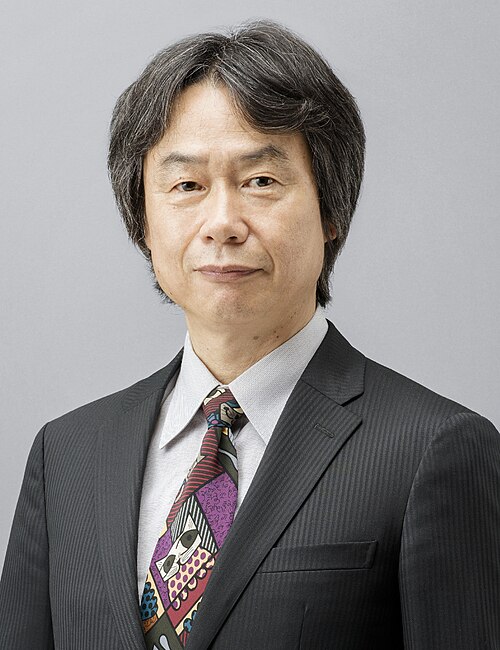
Shigeru Miyamoto is a Japanese video game designer and producer at Nintendo, widely regarded as one of the most important and creative figures in the history of his medium and the creator of the Mario, Donkey Kong, The Legend of Zelda, Star Fox, and Pikmin franchises.15 He has been called the “father of modern video gaming,” and Time magazine dubbed him “The Spielberg of Video Games” in May 1996.26 Games featuring the franchises he created have sold more than a billion copies worldwide.1
Miyamoto was born on November 16, 1952, in the small town of Sonobe, in Kyoto Prefecture, at a time when Japan was still rebuilding from the Second World War.14 His family lived modestly, without a car or a television, and as a child he carved his own toys from scraps of wood and string, letting the fields, forests, and caves around his home become his playground.14 He explored the countryside near his home and, after summoning his courage, ventured into one of the many caves that dotted the landscape—an experience he has cited repeatedly as the inspiration for his sense of exploration and discovery.13 His father was an English teacher.1
Miyamoto developed a passionate love of manga and first aspired to become a manga artist, but instead chose to study industrial design at the Kanazawa Municipal College of Industrial Arts and Crafts, favoring function and user experience over pure aesthetics.14 He struggled academically, taking five years to finish the four-year program, and graduated in the early 1970s without a job lined up.4 The popularity of Taito’s arcade game Space Invaders, released in 1978, encouraged him to enter the video game industry.16
In 1977 Miyamoto’s father arranged, through a family connection, an interview with Nintendo’s president, Hiroshi Yamauchi; at the time Nintendo was a relatively small company that had spent most of its long history making playing cards and toys and had only recently begun experimenting with electronic entertainment.16 He was hired after impressing Yamauchi with a portfolio of toys he had designed and built himself, becoming the company’s first staff artist.24 His earliest assignments were unglamorous—designing the housing for the Color TV Racing 112 console, creating pixel art, and drawing graphics for arcade cabinets such as Sheriff (1979) and Radar Scope.61
Donkey Kong and the Mario franchise
Nintendo’s arcade ambitions faltered in 1981 when Radar Scope failed catastrophically in North America, leaving the company’s American warehouses stuffed with unsold cabinets and its U.S. division near bankruptcy.46 Yamauchi polled the company for ideas to convert the surplus cabinets into a new game, and Miyamoto’s proposal was chosen.6 Approaching the project as an industrial designer rather than an engineer, he began with story and character, basing the game on the love triangle of the Popeye cartoons—the hero Popeye, his rival Bluto, and Olive Oyl.36 When Nintendo could not secure the Popeye license, Popeye became a carpenter, Olive Oyl became a woman named Pauline, and Bluto became a gorilla, from which the game took its name: “Donkey” to convey stubbornness and “Kong” for its association with the 1933 film King Kong.34
Released in 1981, Donkey Kong was an immediate commercial success, with Nintendo selling roughly 4,000 cabinets a month by that October, and it is credited with introducing the platform genre, being the first game in which a character jumps, and making the first use of visual storytelling in a video game through its cut scenes.46 Work on the game and its sequels Donkey Kong Jr. (1982) and Donkey Kong 3 (1983) established Miyamoto as a designer.16 Rather than inventing new characters, Miyamoto preferred to reuse them across new gameplay experiences, which is why Mario and others recur throughout his work.6
The carpenter hero of Donkey Kong, originally called “Jumpman,” was renamed Mario.14 In the follow-up arcade game Mario Bros. Miyamoto gave Mario a brother, Luigi, and reconceived Mario as a mustachioed plumber in overalls; he later explained that the plumber identity followed from that game’s setting among green sewer pipes with turtles emerging from them.111 In 1985 Nintendo released Super Mario Bros. as a launch title for its first home console, known in Japan as the Family Computer and in North America as the Nintendo Entertainment System.16 The side-scrolling action game—whose horizontally scrolling screen Miyamoto devised to expand the playing space vertically as well as horizontally—set the standard for future home-console games, sold more than 40 million units, and is credited with helping to pull the North American industry out of the 1983 video game crash.129 The Super Mario series has sold more than 164 million units worldwide.2
The Legend of Zelda and later work
The year after Super Mario Bros., Miyamoto created The Legend of Zelda (1986), a labyrinthine fantasy game whose sprawling world could take skilled players hours or weeks to complete.19 He drew its sense of exploration directly from his boyhood adventures running through the fields, woods, and caves of the Kyoto countryside.13 Both Super Mario Bros. and The Legend of Zelda became key titles that helped make the NES a success.1
During the Super Nintendo era Miyamoto helped create the Star Fox and F-Zero series and helped design the system’s controller with its innovative left and right shoulder buttons.3 With the Nintendo 64 he was instrumental in Nintendo’s transition from two dimensions to three: he supervised Super Mario 64, a 1996 best-seller with open 3D environments and camera controls that required tweaking the standard joystick to handle more complex commands, and he led The Legend of Zelda: Ocarina of Time, which pioneered enemy lock-on and context-sensitive controls and has been called the greatest video game ever made.239 Other projects of the period include Pikmin, Luigi’s Mansion, Star Fox 64, Mario Kart 64, and The Legend of Zelda: Majora’s Mask.2 By 1998 he had worked on more than 80 Nintendo titles.2
Miyamoto’s design philosophy emphasizes engaging gameplay over technical realism.1 As a boy he was fascinated by the kishōtenketsu format, a four-act structure of introduction, development, twist, and conclusion that emphasizes narrative development and climax without traditional conflict, and he blended these Japanese storytelling sensibilities with influences absorbed from Western television.4 He also helped lead the team that developed the motion-controlled Wii and its Wii Sports and Wii Fit software.16
Within Nintendo, Miyamoto served as general manager of the Entertainment Analysis and Development division from 1984 to 2015 and as senior managing director from 2002 to 2015.16 In 2015 he was named a representative director and Creative Fellow, a role in which he advises on new games rather than directing them day to day.16 As of 2025 he continued to work at the company he joined in 1977, and he has spoken of wishing to stay healthy at least until Mario’s 50th anniversary while stepping back from direct oversight of the franchise.86
In 1998 Miyamoto became the first inductee into the Academy of Interactive Arts and Sciences Hall of Fame.26 He was named to Time’s list of the 100 Most Influential People in 2007, received the BAFTA Fellowship in 2010, and was recognized as a Person of Cultural Merit by the Japanese government in 2019.51 He is the subject of a scholarly biography, Shigeru Miyamoto: Super Mario Bros., Donkey Kong, The Legend of Zelda, by Jennifer deWinter, the inaugural volume in the Influential Video Game Designers series.57 He lives in Kyoto with his wife, Yasuko, and their two children.1
Sources
Kids' encyclopedia entry covering Shigeru Miyamoto's life, career at Nintendo, and creation of iconic game franchises.
kids.kiddle.co · retrieved Jul 2, 2026Academy of Interactive Arts and Sciences special award profile recognizing Miyamoto as the world's greatest video game designer.
interactive.org · retrieved Jul 2, 2026Game developer article spotlighting Miyamoto's history, design philosophy, and influence on video game industry.
gamedeveloper.com · retrieved Jul 2, 2026YouTube documentary exploring Miyamoto's journey from rural Japan to becoming a legendary video game creator.
youtube.com · retrieved Jul 2, 2026Amazon book product page for a critical study of Miyamoto's design decisions and influence on gaming.
amazon.com · retrieved Jul 2, 2026BYU Design Review essay examining Miyamoto's role as Nintendo's creative leader and lessons from his career approach.
designreview.byu.edu · retrieved Jul 2, 2026Deliver to Mexico Hello, sign in Account & Lists Returns & Orders * Health AI * Amazon Haul * Medical Care * Amazon Basics *…
amazon.com · retrieved Jul 2, 2026Reddit discussion thread about Miyamoto stepping back from Mario while expressing hopes to see the franchise thrive.
reddit.com · retrieved Jul 2, 2026Fan-created website exploring Miyamoto's gaming universe and major game franchises he designed.
aboutshigerumiyamoto.weebly.com · retrieved Jul 2, 2026NPR interview with Miyamoto discussing the origins and evolution of Mario and his design approach.
npr.org · retrieved Jul 2, 2026