roguelike
A subgenre defined by dying and starting over, where each descent into a randomly built dungeon is a fresh and usually final chance.
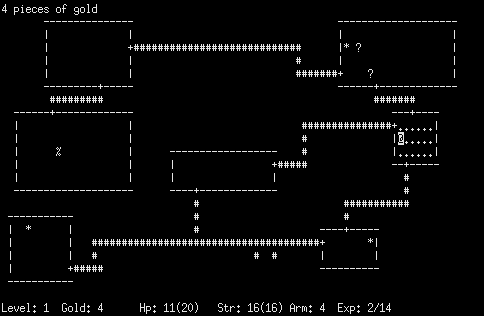
A roguelike is a subgenre of role-playing video game modeled on the 1980 game Rogue, characterized by procedurally generated levels, turn-based movement, and permanent character death.2413 The name derives literally from its progenitor — a “game like Rogue” — and there is no single official definition, only a family of shared traits elaborated by fans and developers over four decades.12 In its most common formulation the player guides a character down through a randomized dungeon, fighting the layout as much as the monsters within it, in an endlessly repeating struggle to master its systems before dying and seeing it regenerate anew.28
Defining traits
Roguelikes are built around a set of interlocking mechanics: permadeath, in which a dead character cannot be reloaded; random or procedural level generation so that no two playthroughs are alike; grid- and turn-based movement, often played at a rapid pace; complex character-object-world interactions; and the need to manage finite resources to survive.28 The genre is generally player-versus-environment, focused on killing or fleeing monsters rather than befriending them, and prizes exploration and discovery on every run — where skill and luck, not memorization, carry the player through.28 Early accounts describe Rogue itself as offering great difficulty, a system of permanent death, tactical combat, a deep simulated world, a unique item-identification system, and high replayability.1
The most cited attempt to formalize these traits is the Berlin Interpretation, a set of “high-value factors” agreed at the International Roguelike Development Conference 2008.28 Its clause that any command should be usable at any time is violated even by some canonical roguelikes, which include overland maps and shopping screens, and no definition commands universal assent.28 Debate over what qualifies persists among players and critics, some of whom favor a rigid reading and others a loose one that extends the label to games structured around failing and restarting.131517
Origins
Rogue did not appear in a vacuum.28 Its most direct ancestor is the tabletop role-playing game Dungeons & Dragons (1974), whose rules for dungeon crawling Rogue adapted in simplified form; the game’s fantasy tone traces further back through that lineage.12 On the PLATO mainframe system, the dungeon-crawlers Pedit5 (1975, probably) and dnd, also known as The Game of Dungeons (1975), were the first computer games to emulate the peril of D&D dungeon crawling, though they had no direct impact on Rogue.28 Pedit5 consisted of 40 or 50 rooms on a single level, while dnd added multiple progressively harder levels, floor traps, and a boss fight.28 Will Crowther and Don Woods’ Colossal Cave Adventure (1977) supplied none of the mechanical trappings besides permadeath but established the theme and tone of an underground adventure filled with riches and danger.28
The single game that first pulled together the randomized dungeon, the item collection, and the monster combat was Beneath Apple Manor (1978), which had a randomly generated dungeon up to ten levels deep, selectable text or graphical rendering, adjustable difficulty, a fog-of-war reveal, and a hidden MacGuffin, the Golden Apple.28 Confined largely to the Apple II until 1983, it never reached the right audience and fell into obscurity, its concept independently reinvented a short time later.28
Rogue and its offshoots
In 1980, University of California, Santa Cruz students Glenn Wichman and Michael Toy set out to randomize the maze layout and item and monster locations of Colossal Cave Adventure, folding in elements of D&D and the mainframe game Star Trek.257 Using the Unix curses library as a text-mode drawing tool, they built a subterranean descent whose graphics were composed of artfully arranged letters, numbers, and punctuation.25 The player’s task was to explore the dungeon, retrieve the Amulet of Yendor — “Yendor” being the protagonist Rodney’s name reversed — and return to the surface, moving one step at a time as in a board game.57 Released the same year as Pac-Man, Rogue remains played and studied decades later.15
Rogue spawned a family of variants and successors, many of them console-based ASCII games.1 Moria, released in 1983, took a Tolkienesque name and tasked the player with descending to defeat the Balrog; it was the first to feature a town where weapons, armor, and supplies could be bought.410 Hack, distributed via newsgroups in December 1984, was an improved Rogue that added a pet dog, new classes, extra items, and food management.410 Larn (1986) was the first to connect multiple dungeons through a town, and the late-1980s Omega introduced a vast explorable countryside.410 Several games spawned their own lineages: Moria was modified into UMoria and then Angband, while Hack became NetHack, whose current version was released in December 2003 after nearly fifteen years of development and which appeared on Time’s list of the all-time top 100 video games.1410
Later standalone roguelikes broadened the field. Ancient Domains of Mystery (ADOM), first released in 1994, offered an unusually detailed storyline, persistent dungeons, quests, and multiple endings, and later raised over $90,000 in a crowdfunding campaign to resume development.410 Tales of Maj’Eyal (ToME), originally “Tales of Middle Earth” and built on Angband, became one of the more accessible entries with a graphical interface, music, and sound.410 Franchise-themed variants such as Doom, the Roguelike (DoomRL), set in id Software’s Doom universe, exemplified the “coffee-break roguelike” — designed to be fast and simple rather than slow and tactical.4
Naming and community
The term “roguelike” was consolidated on Usenet in the early 1990s.9 On July 2, 1993, Andrew Solovay posted a “Request for Discussion” proposing a new newsgroup hierarchy, rec.games.dungeon, to group discussion of “rogue-type” games sharing a character-based display and high portability.69 The original grouping was justified not by procedural generation, permadeath, or turn-based play but chiefly by the shared character-based interface.9 Because “dungeon” was judged too broad — one early version of Zork was itself named “dungeon” — participants proposed naming the hierarchy after Rogue, “the granddaddy of these games,” and a second Request for Discussion narrowed the definition to games descended from Rogue.69 Through constant use, the term acquired an evolving, collective meaning that remained relatively stable until the 2010s.9
Modern resurgence
Long a niche pursuit, roguelikes surged in prominence during the 2010s with the growth of the indie scene, when more action-focused games began adopting the label.9 Before that revival, the closest to mainstream roguelikes were Japan’s Mystery Dungeon series and the Diablo games; by the mid-2010s, roguelike had become one of the most common tags on Steam, with 108 games so tagged as one commentator counted.1 Spelunky, once a promising freeware release, grew into a widely played real-time roguelike-inspired game across Xbox 360, PS3, Vita, and Steam, and became a fixture of livestreams and video captures.1
The genre’s growth also loosened its boundaries.28 Not all roguelikes take place in dungeons: Shattered Planet by Kitfox Games is set in space, Hoplite casts the player as a lone Greek soldier descending into a lava-filled dungeon after the Fleece of Yendor, and Out There recasts the formula as a melancholic space voyage closer to a choose-your-own-adventure book.57 Many later games are described as “roguelites,” a related term for run-based games in which the player retains upgrades or bonuses between attempts rather than losing everything — a more recent innovation not part of the original definition.1617 Modern acclaimed examples span genres, from Supergiant Games’ dungeon crawler Hades to the deck-builder Slay the Spire and the action-platformer Dead Cells.1520 By 2020, roguelike ideas — extreme randomness, ASCII graphics, permadeath, and enormous complexity — had spread so widely that a great many games had been at least influenced by the genre even where they were not strictly roguelikes.28
Sources
A Game Developer column reviving coverage of roguelikes, their recent mainstream popularity, and foundational genre concepts.
gamedeveloper.com · retrieved Jul 4, 2026Ars Technica's comprehensive history of roguelike games from Rogue to modern titles, covering genre definition and evolution.
arstechnica.com · retrieved Jul 4, 2026MakeUseOf guide to roguelikes explaining the genre's origins, classic games like NetHack and Moria, and modern examples.
makeuseof.com · retrieved Jul 4, 2026The New Yorker essay on roguelikes examining how permadeath and procedural generation define the genre and its cultural significance.
newyorker.com · retrieved Jul 4, 2026A 1993 Usenet proposal to create discussion hierarchies for rogue-type games, tracing early community organization of the genre.
groups.google.com · retrieved Jul 4, 2026New Yorker archive article discussing roguelikes' permadeath mechanics and highlighting mobile games like Hoplite and Out There.
web.archive.org · retrieved Jul 4, 2026Ars Technica archived article covering roguelike history and the Berlin Interpretation's formal definition of core genre mechanics.
web.archive.org · retrieved Jul 4, 2026A developer's historical research on the origin of the term "roguelike" and its evolution through Usenet discussions in 1993.
web.archive.org · retrieved Jul 4, 2026MakeUseOf archived guide to roguelike games covering classic titles, Tale of Maj'Eyal, and NetHack with gameplay overview.
web.archive.org · retrieved Jul 4, 2026Polygon article exploring flexible definitions of roguelike, debating genre boundaries with examples like Getting Over It and Outer Wilds.
polygon.com · retrieved Jul 4, 2026New York Times guide explaining roguelike mechanics, procedural generation, permadeath, and recommendations for newcomers.
nytimes.com · retrieved Jul 4, 2026Steam community forum discussion clarifying that roguelikes feature permadeath and procedural generation, not skill carryover between runs.
steamcommunity.com · retrieved Jul 4, 2026PC Gamer forum explaining the distinction between roguelikes (no progression between runs) and roguelites (earned upgrades persist).
forums.pcgamer.com · retrieved Jul 4, 2026Eneba's curated list of 30 best roguelike games with detailed reviews of titles like Hades, Slay the Spire, and Dead Cells.
eneba.com · retrieved Jul 4, 2026