PICO-8
A game console that never physically existed, built to make small, strange games by ruling out almost everything but the idea.

PICO-8 is a fantasy video game console — a virtual machine and integrated game-making environment created by Lexaloffle Games that emulates the deliberately limited audio-visual capabilities of 8-bit systems from the 1980s.313 It was designed by Joseph White, who works under the alias “zep,” and the software’s manual carries a Lexaloffle Games LLP copyright dated 2014–2025.413 Rather than reproducing any single historical machine, PICO-8 imposes an invented set of “harsh limitations” chosen, in the manual’s words, to “encourage small but expressive designs and hopefully to give PICO-8 cartridges their own particular look and feel”.4
The console’s fixed specifications define its identity: a 128×128 display drawing on a 16-color palette, cartridges of 32 kilobytes, four channels of sound described as “chip blerps,” and code written in a variant of the Lua programming language.34 A virtual CPU runs at 4 million VM instructions per second, and graphics are built from a single bank of 128 sprites (with 128 more shared) at 8×8 pixels apiece, over a tilemap of 128×32 tiles.4 Input is handled through six-button controllers, with default keyboard mappings such as the cursor keys plus Z and X for the first player.4 Programs are further capped at 8,192 tokens of code, a limit that forces compact designs.416 Beyond the 16 default colors — running from black through dark blue, dark purple, red, orange, and peach — PICO-8 also carries 16 “hidden” colors, sometimes addressed as negative numbers, accessible through less obvious means.7
The cartridge system
PICO-8’s most distinctive technical trait is that its “cartridges” are saved as ordinary PNG image files, each encoding up to 32k of data behind a picture of a cartridge.313 These .p8.png files can be sent directly between users, played in a web browser, or exported as stand-alone HTML5, Windows, Mac, and Linux applications.3 When saving in the PNG or raw ROM format, the compressed code must fit under roughly 15 kilobytes so the total cartridge stays within 32k.4 Any cartridge can be reopened inside PICO-8 to study or modify its code, graphics, and sound, making every published game a readable example.319 The 2020s versions raised the multicart export limit to 32 cartridges in a single bundle, aimed at authors assembling “n-in-1” game collections.1
The software bundles integrated editors for code, sprites, maps, sound effects, and music, so a creator never leaves the environment.1517 On boot it presents a Lua shell against a black screen, from which built-in demo cartridges — including a platform demo called JELPI and a 2.5D raycaster called CAST — can be installed and inspected.416 Games are built around two central callback functions, _UPDATE and _DRAW, and simple drawing commands such as cls, rect, circfill, and spr.415 A built-in browser called SPLORE lets users browse, favorite, and download community cartridges from Lexaloffle’s bulletin-board system, described by one writer as “basically Netflix for tiny games”.113 Version 0.2.7, the release documented as of July 2026, added features such as rounded-rectangle drawing primitives, background prefetching of cartridges for offline play, and a security patch closing a buffer-overrun vulnerability that could affect untrusted carts run locally.1
Distribution and hardware
PICO-8 is commercial software: as of 2026 a one-off purchase of \$14.99 provides the full version for Windows, Mac, Linux, and Raspberry Pi, sold through Lexaloffle, Humble, and itch.io.131 A free educational version runs in the browser at pico-8-edu.com.15 The application is small and undemanding, running on hardware as modest as a roughly 700 MHz Raspberry Pi, so old netbooks and microcomputers can be turned into PICO-8 machines.3 Its virtual drive can be mapped to a cloud folder such as Dropbox or Google Drive to share a single disk across several host machines.4
In 2016 the console gained a quasi-physical form when it shipped preinstalled, with a library of built-in games, on Next Thing Co.’s \$49 PocketCHIP handheld computer, a portable Linux device with a 4.3-inch 480×272 resistive touchscreen and QWERTY keyboard.1210 Commentators noted that shipping PICO-8 on a portable was likely to expose a broader audience to both its creators’ work and its Lua-based development environment.12 The paid version also runs on later retro handhelds such as the RG Cube XX and, via community wrappers, on Android devices.13
Community and notable games
PICO-8 has fostered an active community that collaborates through Lexaloffle’s forums and shares tools, code snippets, and tutorials.3 By 2026 the library exceeded 16,000 free games spanning nearly every genre, from arcade titles and roguelikes to golf, solitaire, and Metroidvanias.1314 A recurring cultural form on the platform is the “demake,” a stripped-down reimagining of a larger game: examples include Poom, a take on Doom, and Alone in Pico, Antoine Zanuttini’s 2015 remake of the 1992 survival-horror title Alone in the Dark, which reproduced the original’s 3D mansions within the 128×128, 16-color frame while dropping its inventory and combat systems.149 That original — following supernatural detectives Emily Hartwood and Edward Camby through a haunted mansion — is credited by Guinness World Records as the first 3D survival-horror game, and its author found its mesh complexity feasible to approximate in PICO-8.9
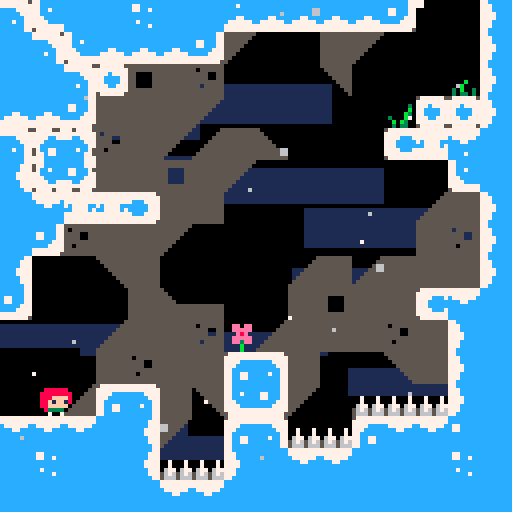
The most consequential PICO-8 game is Celeste Classic, a hard platformer that later grew into the full commercial Celeste, which went on to release across modern systems.1314 The movement code of the original Celeste was released under an MIT license, allowing others to build on it.19 Other games began on PICO-8 before expanding, including Wood Worm, and collections such as Adam Saltsman’s Corgi Space — expanded with additional games and a “corgi jam” after release — and Sebastian Lind’s Sebi 16 bundle multiple constrained games in a manner compared to UFO 50.14
PICO-8’s culture of print extends to fanzines: the 48-page PICO-8 Fanzine #1, published in August 2015 by the collective sectordub, gathered tutorials and a history of the console, with contributions from White himself alongside figures including Terry Cavanagh and Devine Lu Linvega.2 Developers Arnaud de Bock and François Alliot used PICO-8 to make Passengers, a game about the European migrant crisis.12
Design philosophy and lineage
PICO-8 grew out of a sandbox White was building for a game before it “mutated into an entire ecosystem”.13 Its guiding idea is that constraint fosters creativity: by curbing ambition, it makes the gap between what a beginner can build and what they might buy feel small enough to be inviting.1320 Developers repeatedly describe its integrated, “cozy” environment and its enforced simplicity as what draws them to it over fully-featured engines like Godot or LibGDX.1520 Because any loaded cartridge exposes its full source and assets, the platform is widely recommended as a way to learn programming through instant feedback.1619
The console draws its aesthetic from the 8-bit and early 16-bit home machines of the 1980s — the Atari 2600, Commodore 64, and NES among them — that its creator and users grew up with, though it corresponds to no single one of them.1318 Community analyses place its specifications between eras: its 32k cart size and sprite count echo the NES, its work RAM the Sega Genesis, its sound chip somewhere between the Commodore 64’s SID and the PC Engine’s HuC6280, and its Lua-driven mathematical capabilities the later 32-bit machines such as the PlayStation.18 Its rounded API and the RRECT drawing primitive were shared with Lexaloffle’s later fantasy workstation Picotron and its voxel-based sibling Voxatron.15
PICO-8 in turn helped define the “fantasy console” as a category and inspired the broader wave of self-limited indie collections; the retro-styled UFO 50 is cited as kin to the platform’s own bundle culture.1417 As a first environment for learning to program, it has been widely recommended as an on-ramp to game development.151617
Sources
Release notes for PICO-8 version 0.2.7, introducing new API features like rounded rectangles, text styling, and cartridge prefetching capabilities.
lexaloffle.com · retrieved Jul 7, 2026A 48-page downloadable fanzine about PICO-8 covering its history, game development tutorials, music creation, and programming examples.
sectordub.itch.io · retrieved Jul 7, 2026Official PICO-8 homepage describing the fantasy console's specifications, creative tools, shareability features, and system requirements.
lexaloffle.com · retrieved Jul 7, 2026The comprehensive PICO-8 user manual documenting specifications, getting started guides, editing tools, Lua syntax, and API reference.
lexaloffle.com · retrieved Jul 7, 2026Development diary for Voxatron, a 3D voxel-based game engine, discussing upcoming features like custom objects, physics, and resource management.
lexaloffle.com · retrieved Jul 7, 2026Educational guide to PICO-8's 16-color default palette and hidden palette, with analysis and color ramps for pixel art creation.
nerdyteachers.com · retrieved Jul 7, 2026Article about a PICO-8 demake of the classic horror game Alone in the Dark, demonstrating how creative limitation preserves gameplay essence.
killscreen.com · retrieved Jul 7, 2026Archived documentation for PocketC.H.I.P., a portable Linux handheld device with touchscreen and keyboard capabilities.
web.archive.org · retrieved Jul 7, 2026News article announcing PICO-8's pre-installation on Next Thing's PocketCHIP portable computer as a way to reach broader audiences.
web.archive.org · retrieved Jul 7, 2026Feature article celebrating PICO-8 as an accessible retro gaming platform with thousands of free games and strong creative community.
stuff.tv · retrieved Jul 7, 2026Video essay exploring PICO-8's design philosophy, creative limitations, and diverse game library spanning multiple genres.
youtube.com · retrieved Jul 7, 2026Tutorial series teaching game development fundamentals by building a tower defense game step-by-step in PICO-8.
mike.sg · retrieved Jul 7, 2026Personal account of learning game development through PICO-8, exploring its integrated tools and beginner-friendly approach.
medium.com · retrieved Jul 7, 2026Beginner's guide to installing PICO-8 and creating first sprites and game elements using the fantasy console.
dev.to · retrieved Jul 7, 2026Forum discussion comparing PICO-8's specifications to classic video game consoles to determine its hypothetical release era.
lexaloffle.com · retrieved Jul 7, 2026GDC talk demonstrating rapid game prototyping in PICO-8 by building a playable platformer within 30 minutes.
youtube.com · retrieved Jul 7, 2026Personal reflection on discovering PICO-8 for game development and how its constraints provide encouraging creative boundaries.
wbrawner.com · retrieved Jul 7, 2026