Ōkami
A sun goddess in the form of a white wolf restores color to a blighted Japan by painting the world back to life with a magical brush wielded through the controller’s analog stick.

Ōkami is a 2006 action-adventure video game developed by Clover Studio and published by Capcom, set in a mythologized classical Japan and built around a “Celestial Brush” mechanic that lets the player alter the world by drawing with the controller.2312 Its title is a pun: written 「大神」 it means “great god,” while the homophone ōkami means “wolf” — apt for a protagonist who is the sun goddess Amaterasu in the form of a white wolf.2312 The game combines Japanese mythology and folklore to tell how the land is saved from darkness by Amaterasu, whose celestial markings cover her fur.23 It was among the last major PlayStation 2 titles selected for release before the arrival of the PlayStation 3.23
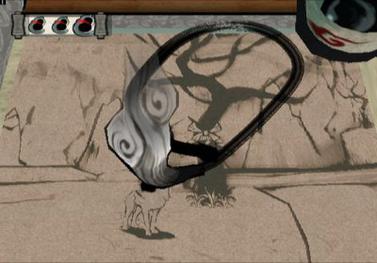
The story opens a century after the brave warrior Nagi and the sun god in wolf form defeated the eight-headed demon Orochi, whose curse had drained the land of life and color.6 When a shadowed, power-hungry figure removes Nagi’s legendary sword from the shrine protecting Kamiki village, Orochi is freed and the curse of darkness spreads again; the ailing wood nymph Sakuya musters her last strength to call upon the village’s white-wolf statue, and Amaterasu materializes to face the reborn curse.6 After roughly fifteen minutes of introductory storytelling, the player slips beneath the fur of the wolf, whose steps cause grass to sprout and whose leaps scatter autumn leaves, cleansing an ancient Japan blighted by a spoiling plague.6813 Amaterasu is guided by Issun, a wandering artist-spirit sidekick who does the talking for the silent protagonist and provides much of the game’s humor and charm.1312
Central to play is the Celestial Brush, triggered by freezing the on-screen world and painting with the PlayStation 2 controller’s right analog stick.8 Brush techniques include a horizontal line for a slashing “Slash,” a circle-and-fuse “Sakura Bomb,” and strokes that draw bridges over water, restore a broken sword, bring flowers to a withered tree, light torches from a flame or water source, or complete constellations in the sky to win new brush powers from other gods.1312 Amaterasu’s divine standing depends on the faith of the people she helps, growing as she fulfills their wishes — the game favors a prompt to “listen” over the more usual command to “talk”.128 The game is a metroidvania-style open world with regular backtracking to reach new places using newly gained abilities; its main quest loops back on earlier areas rather than moving in a straight line, and it runs roughly 40 to 50 hours.13
Art style and inspiration
Ōkami’s visuals are a vibrant interpretation of Japanese ink-wash painting, known as sumi-e, rendered in thickly inked strokes, harsh lines, cross-hatching, and soft ink washes; cartoonish characters are outlined in thick blacks, and a special effect makes the screen appear made of parchment rather than glass.128 The look was partly born of necessity: the game was initially intended to use realistic rendering, which strained the PlayStation 2, so cel-shading was chosen to reduce processing, yielding a combination of Japanese watercolor aesthetics and the hardware’s technical constraints.13 The world begins gray-toned, and the goddess’s task is to restore color to the landscape by overcoming enemies.1213 Its “nature adventure” framing draws on Shinto, in which rocks, trees, rivers, and mountains are revered as sacred entities, and the game’s delicate details are drawn from Japan’s religio-historical past in a manner more playful than pedantic.12 The 2005 preview build recalled the landscapes of the 15th-century painter Sesshū Tōyō, and a 1UP writer likened the brush-driven interplay of art and play to NanaOn-Sha’s calligraphic game Mojib-Ribbon.12

Ōkami was directed and written by Hideki Kamiya, previously the director of Resident Evil 2, Devil May Cry, and Viewtiful Joe, while Clover Studio’s CEO and president Atsushi Inaba handled promotional duties.914 Capcom had by then been positioning itself as something of an art house for games, publishing risky, stylized titles such as Viewtiful Joe and Killer 7 and releasing them in North America despite the challenge of localizing an intimately Japanese work.12
Contemporary critics repeatedly compared the game to Nintendo’s The Legend of Zelda series: like the Zelda hero Link, Amaterasu begins her affairs small and divides her time between visiting villages and gaining new abilities in dungeons, and both Ōkami and the then-recent The Wind Waker rejected graphical realism for a hand-drawn look.8 Reviewers noted that the next Zelda, Twilight Princess, likewise featured a wolf, and described Ōkami’s narrative structure and delivery as so close to Zelda as to be “all wolf and no Link”.86 One reviewer likened its lyrical whimsy to The Wind Waker and to a more serene Jet Set Radio.12 The MTV feature also grouped its world-shaping powers with “god games” such as SimCity and Civilization, while noting that in Ōkami the changes happen at ground level around the wolf rather than from a distant viewpoint, and framed the game as an unusually gentle, pro-environment title amid a medium built on destruction.8
Release and reception
Ōkami was released for the PlayStation 2 in 2006 in Japan and North America, and in 2007 in Europe and Australia.23 Despite poor sales, it earned wide critical acclaim, taking IGN’s 2006 Game of the Year and, by Capcom’s count, more than 30 awards across Western territories, including an Associated Press “#1 Best of 2006”.2316 IGN’s review called it “beautiful, charismatic, engaging and one of the most original games you’ll play,” recommending it to any PlayStation 2 owner “simply because you’ve never played anything like it before,” and faulting only minor issues such as a sluggish camera in battle.114
Clover Studio was shut down a few months after release, and several of its key members went on to found PlatinumGames.13 Capcom released Ōkami HD, a remaster presenting the sumi-e art in high resolution with HD filtering options, for the PlayStation 3 on October 30, 2012, distributed through the PlayStation Network with PlayStation Move support, trophies, and Platinum trophies.2316 Wider ports followed: the Steam version arrived on December 12, 2017, and the Nintendo Switch version on August 9, 2018, the latter adding Joy-Con gesture and touch-screen Celestial Brush controls in handheld mode.1715 The Switch and Steam editions let players choose widescreen or the original 4:3 aspect ratio.1517
In 2024 a direct Ōkami sequel was announced, with Hideki Kamiya returning as director; it is co-developed by studios including M-TWO Inc., Machine Head Works Inc., and Kamiya’s own CLOVERS Inc., which he joined as studio head and chief game designer in October 2024.14 Kamiya, born in 1970 in Matsumoto, Nagano prefecture, had by then also directed Bayonetta and The Wonderful 101.14 To mark the announcement, Capcom released an Ōkami + Kunitsu-Gami bundle pairing Ōkami HD with Kunitsu-Gami: Path of the Goddess.14
Sources
IGN's review praising Okami as a triumphant blend of hand-drawn aesthetics and game design capturing mythical Japan, despite minor camera issues.
ign.com · retrieved Jul 11, 2026Play.tm review describing Okami as a beautifully crafted adventure with Zelda-like structure and one of PS2's most visually stunning games.
web.archive.org · retrieved Jul 11, 2026MTV article discussing how Okami's environmental themes and hand-drawn art style make it an unconventional game about beautifying and restoring the world.
web.archive.org · retrieved Jul 11, 20261UP interview with director Hideki Kamiya discussing his creative inspirations and approach to developing Okami and his other acclaimed games.
web.archive.org · retrieved Jul 11, 2026IGN's review calling Okami beautiful, charismatic, and one of the most original PS2 games, essential for PlayStation owners.
ign.com · retrieved Jul 11, 2026Detailed preview of Okami highlighting its sumi-e ink art style, celestial brush mechanics, and cultural Japanese elements from Tokyo Game Show.
web.archive.org · retrieved Jul 11, 2026Personal gaming blog review praising Okami's stunning art style, engaging story, and character design while discussing its appeal compared to other games.
shetanislair.com · retrieved Jul 11, 2026Official Capcom announcement of an Okami sequel in development directed by Hideki Kamiya with original studio members.
capcom-games.com · retrieved Jul 11, 2026Nintendo Switch store page for Okami HD with game description, features, and compatibility information.
nintendo.com · retrieved Jul 11, 2026Official Okami game website showcasing HD visuals, Move support, critical acclaim, and noting over 30 awards won since 2006.
okami-game.com · retrieved Jul 11, 2026Steam store page for Okami HD with very positive user reviews and game tags emphasizing its acclaimed status and visual style.
store.steampowered.com · retrieved Jul 11, 2026Fandom wiki entry documenting Okami as a 2006 action-adventure by Clover Studio about the sun goddess Amaterasu restoring Japan from darkness.
okami.fandom.com · retrieved Jul 11, 2026