Nintendo Entertainment System
The grey, toy-like box that defied a collapsed American market and made Nintendo synonymous with the home video game for a generation.
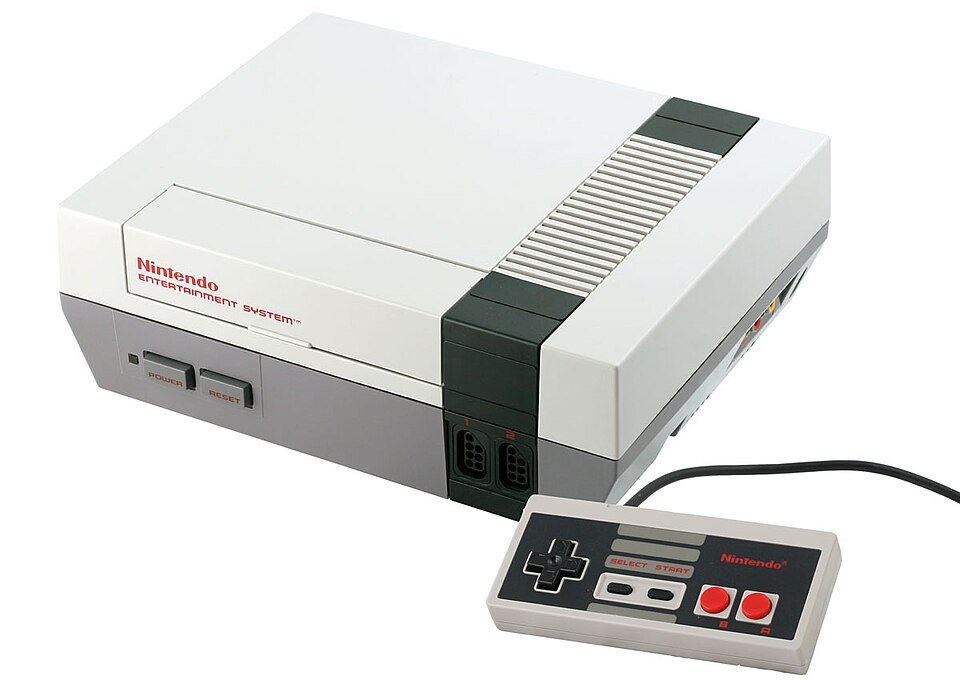
The Nintendo Entertainment System (NES) is an 8-bit home video game console developed and manufactured by that was first released in Japan as the Family Computer (Famicom) on July 15, 1983, and launched in the United States in 1985.1121 It was Nintendo’s first internationally successful programmable home console, and is widely credited with reviving an American video game industry that had collapsed in the early 1980s.1120 Over its lifetime the system sold 61.91 million units worldwide 11, a figure the company’s own regional accounting records as roughly 6,191 in ten-thousand-unit increments — about 19.35 million in Japan, 34 million in the Americas, and 8.56 million in other regions.1 Software sales across the platform totaled some 500 million Game Paks worldwide, split roughly evenly between Japan and the Americas.1
Origins and the Famicom
Nintendo’s path to the console ran through arcades. Founded in 1889 by Fusajiro Yamauchi as a maker of hand-painted hanafuda playing cards — a name that translates roughly as “leave luck to heaven” — the company adopted the name Nintendo Co., Ltd. in 1963 and shifted toward games and toys as the card market faltered in the 1960s and 1970s.11 It briefly diversified into an instant-rice business and a hotel chain, neither of which proved lucrative.11 After early home efforts with the dedicated Color TV-Game 6 and Color TV-Game 15 systems — named for the number of games each played — Nintendo found its first major hit in , a 1981 arcade game designed by featuring a giant ape and a leaping character called Jumpman.11 Nintendo sold the rights to Donkey Kong to American console makers such as Atari, Intellivision, and ColecoVision before deciding it would be more profitable to build its own hardware.11
President Hiroshi Yamauchi wanted an affordable cartridge-based machine that would let people play arcade-quality games at home without leaving the house.2021 Original plans called for an advanced 16-bit system with a keyboard and floppy disk drive, but Yamauchi rejected these features as intimidating to non-technical buyers and opted for a cheaper, conventional cartridge console.21 Early Famicom games were written on a system that ran on an NEC PC-8001 computer, with graphics designed on an LED grid and a digitizer because no software tools for the purpose then existed.21 Unveiled in Japan in July 1983, the Famicom — short for Family Computer — featured eight bits of memory and shipped with three games: Donkey Kong, Donkey Kong Jr., and Popeye.114 Sales began slowly but accelerated with the 1985 release of , a Miyamoto-designed game that renamed Jumpman as Mario and set him in a world of pipes, floating blocks, and flying turtles.11 The Famicom sold more than two and a half million units in Japan alone, though an early hardware fault could freeze the screen on power-up — a defect Nintendo addressed in redesigning the machine for overseas markets.4
Coming to America
Nintendo’s first plan for the United States, a machine to be called the Advanced Video System, was a prototype poorly received because of its high price and the still-unfavorable market.1112 The American video game industry had collapsed after publishers flooded the market with quickly made, low-quality titles sold on expensive ROM cartridges; high-profile failures such as Atari’s E.T. the Extra-Terrestrial and a limited Pac-Man conversion had exhausted consumer trust, with magazines warning by 1985 that the market for video games was almost nonexistent.1216 Atari was so confident the E.T. game was unsalvageable that it buried thousands of copies in a New Mexico desert.4 Players had turned instead to floppy-disk games on home computers such as the Commodore 64 and Apple II, where titles were cheaper and often more sophisticated.16
Nintendo responded by redesigning the console and its marketing to distance it from video games entirely.12 The playful red color scheme of the Famicom gave way to a serious grey, the machine was styled to resemble a high-end toy or piece of hi-fi equipment, and the rebranded “Nintendo Entertainment System” used a vocabulary of its own: games were “Game Paks” and the console a “control deck”.1211 To control software quality, Nintendo imposed a strict licensing agreement under which outside developers were held to quality standards and limited in the number of titles they could produce each year.11 A 10NES lockout chip in the console electronically blocked unauthorized cartridges from running.11
The NES was released in a few New York City stores in October 1985, bundled with Super Mario Bros. and the target-shooting game Duck Hunt.114 After solid sales in the 1985 holiday season, Nintendo ordered a full North American launch.11 Buoyed in part by the 1986 role-playing game The Legend of Zelda, the system sold 2.3 million units in 1987 and 6.1 million in 1988.11
Hardware and library
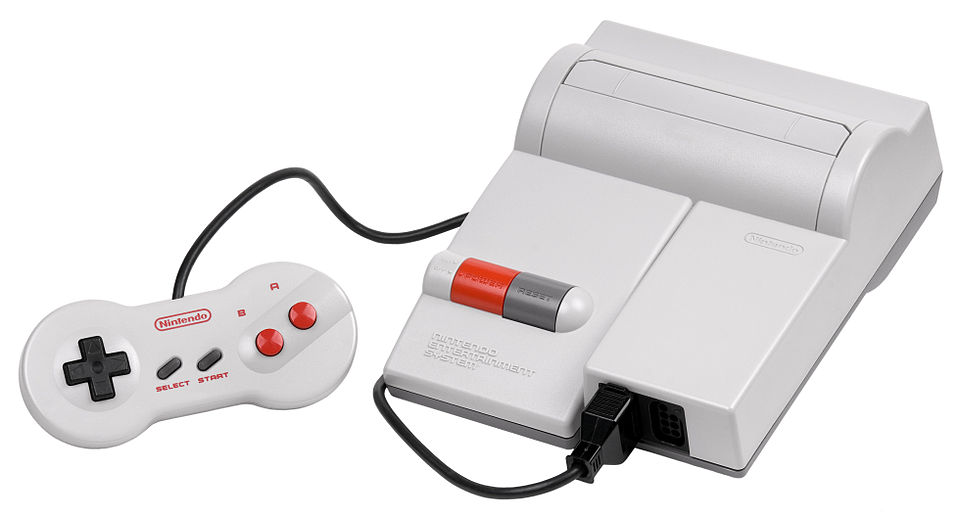
The NES controller — a horizontal slab of plastic with a cross-shaped directional pad, two round action buttons, and “Start” and “Select” buttons — established a layout that became an industry standard that still resonates today.1314 The console accessory range included the Nintendo Zapper light gun, originally packed in with Duck Hunt, and a series of other innovative, futuristic-looking peripherals meant to set the system apart.1512 Over its life the NES amassed a library of more than 500 titles 1314, including Miyamoto’s Excitebike, Metroid, Kirby’s Adventure, Kid Icarus, Contra, and Final Fantasy.134 Mario himself recurred across genres, appearing as a golfer in Golf and later in NES Open Tournament Golf.7 The best-selling NES game was Super Mario Bros. with 40.24 million copies, although many of those sales came from bundling with the console; the best-selling standalone title was Super Mario Bros. 3, released in 1990, with 18 million copies.11
International release and decline
Outside Japan and North America, Nintendo’s rollout was uneven, and claims that the NES was a uniform worldwide success have been described as categorically incorrect.8 In the United Kingdom the NES launched in 1987 but made little early impact, hampered by a vibrant home-computer market dominated by machines such as the Commodore 64, ZX Spectrum, and Amstrad CPC464, by the entrenched , by cartridge prices that ran roughly £10 above Sega’s, and by limited retail distribution under Mattel, which initially signed up only Boots the Chemist to stock the system.12 Established home-computer piracy on cheap cassette tapes further undercut the cartridge model.12 A breakthrough came after distribution passed to a smaller company called San Serif, whose 1990 pack bundling the control deck with a Teenage Mutant Hero Turtles game propelled the console to UK success and led players to discover the rest of its catalogue.12 The system reached India in 1987 through Samurai India, an authorized reseller of Active Boeki K. K. of Kobe, which distributed Nintendo for South-East Asia, the Middle East, and India.9 It reached South Africa only in 1993 — released as a distinct “South African Version” derived from a German PAL box and bundled with Super Mario Bros. — where Taiwanese “Famiclones” such as the “Golden China” and a store-branded “Reggie’s Entertainment System” had long preceded it.5 It arrived in Chile only in 1991.4
The NES was superseded by the Super Nintendo Entertainment System (SNES) in 1991, though Nintendo continued selling the NES in the United States until 1995.11 In Japan the last unit was produced in 2003.11 In November 2016 Nintendo released the NES Classic Edition, a miniature reproduction preloaded with thirty games; it sold an estimated 2.3 million units before discontinuation in April 2017 and was rereleased for a limited period between June and December 2018.11 The NES library was later made available through the Nintendo Switch Online subscription service beginning September 18, 2018, offering a curated selection of more than 100 NES and Super NES titles with online play and rewind features.19
Sources
Nintendo consolidated sales data for fiscal years 1998-1999 covering NES, DS, 3DS, and Wii U software and hardware.
nintendo.co.jp · retrieved Jun 29, 2026Article chronicling the NES's 40-year history, its global impact of 61 million units sold, and legacy in gaming industry.
theclinic.cl · retrieved Jun 29, 2026Research article on Nintendo's NES market presence in South Africa during the early 1990s amid pirate clones.
web.archive.org · retrieved Jun 29, 2026Guardian article listing 25 trivia facts about Super Mario Bros. and character Mario's 25-year history.
web.archive.org · retrieved Jun 29, 2026LinkedIn article examining Nintendo's NES operations in South Africa and overlooked gaming history outside USA and Japan.
linkedin.com · retrieved Jun 29, 2026Interview about Nintendo Wii and DS Lite launch in India in 2008, with pricing and distributor information.
m.rediff.com · retrieved Jun 29, 2026EBSCO research starter overview of the NES console's 1985 US launch and role in revitalizing the video game industry.
ebsco.com · retrieved Jun 29, 2026National Videogame Museum exhibit page detailing NES design changes, US market recovery, and UK market challenges.
thenvm.org · retrieved Jun 29, 2026Nintendo official page describing the NES's origins as Famicom, game library, and iconic controller design.
nintendo.com · retrieved Jun 29, 2026Nintendo UK official page about the NES system history, 500-title game library, and controller innovation.
nintendo.com · retrieved Jun 29, 2026Price Charting video game marketplace offering NES console pricing and sales data across regions.
pricecharting.com · retrieved Jun 29, 2026TechSpot feature article on the NES as a legendary gaming console that saved the video game industry.
techspot.com · retrieved Jun 29, 2026Nintendo Switch Online subscription service offering 100+ classic NES and Super NES games for digital play.
nintendo.com · retrieved Jun 29, 2026Brief history of the NES console and its revolutionary impact on American video gaming during the 1980s.
livenowfox.com · retrieved Jun 29, 2026Blog post on the NES development history from Famicom concept through 1995, covering design decisions and specifications.
hiscoga.wordpress.com · retrieved Jun 29, 2026