Moon Patrol
A moon buggy bouncing across cratered lunar terrain to a bass groove that lodged itself in the memory of a generation of arcade-goers.

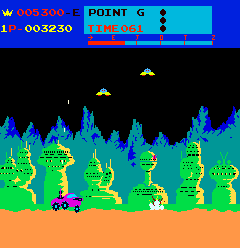
Moon Patrol is a horizontally scrolling shooter arcade game developed by the Japanese company Irem and released in 1982.813 In North America it was manufactured and distributed by Williams Electronics, which licensed the title from Irem.813 The player controls a lunar rover — commonly described as a moon buggy — that drives continuously across a scrolling lunar landscape while jumping over craters, rocks, and land mines and shooting simultaneously at obstacles ahead and enemy craft above.818 The object is to complete the varying legs of a patrol course as quickly as possible while avoiding hazards and enemy attack.8

The buggy carries two guns: a short-range cannon that fires ahead to blast rocks blocking the path, and an anti-aircraft gun that fires upward to defend against attacking saucers, both operated at once.8 Most rocks crumble in a single hit, while larger ones require two, and tiny rocks must be destroyed with precise shooting or jumped over.8 A two-way joystick regulates the buggy’s speed between a faster and a slower setting, while two buttons handle firing and jumping.8 Enemy hazards include spinning saucers that bomb the ground ahead to create fresh craters and hovering enemy craft that stalk from behind before charging, which the player must jump over and then destroy on the way down.8
The course is divided into legs marked by 25 checkpoints, each symbolized by a letter from A to Z, with the buggy driving continually to the right from one lunar station toward the next.817 Reaching a checkpoint at points E, J, O, T, or Z evaluates the player against an average time — 59 seconds being the fastest possible interval — and awards bonus points for beating it, while completing the course to point Z grants a special bonus in addition to any time bonus.8 The game records the best times to reach these points.8 A row of three status indicator lights at the top of the screen warns of approaching danger: an upper light for incoming saucers, a middle light for a minefield, and a lower light for an enemy stalking from behind.8 On completing the Beginner’s Course, the player advances to a harder Champion or Expert Course, which then repeats after successful completion.816 The game supports a maximum of two players in alternating play.8
Design and technology
The game was designed by Takashi Nishiyama, who described it as the second game he worked on at Irem after UniWar S, an early title he built using Namco’s Galaxian hardware.9 Nishiyama recalled it as a game in which “the player drives a buggy across the moon’s surface while avoiding craters and rocks and being attacked by UFOs,” and confirmed it was distributed by Williams in the United States.9 He had joined Irem after taking a part-time job there and writing a concept document for a shooter, which his boss encouraged him to develop into a career.9 Nishiyama later left Irem for Capcom, where he designed the original Street Fighter, and went on to oversee development at SNK on series including Fatal Fury, The King of Fighters, Samurai Shodown, and Metal Slug.913 Before leaving Irem he also produced Spartan X, known overseas as Kung-Fu Master.913
Moon Patrol is frequently credited with popularizing full parallax scrolling, in which foreground and background terrain scroll at different rates to create an illusion of depth.813 According to one account, though Alpha Denshi’s Jump Bug was the first game to use limited parallax scrolling, Moon Patrol employed it more effectively in the traditional manner, drawing on concepts from the multiplane cameras of traditional animation.13 The same account credits Moon Patrol as the first arcade game to let a player continue for the price of another credit, and notes its traffic-light-style status display among its innovations.13
The arcade cabinet used a 19-inch Wells-Gardner horizontal raster color monitor and was offered as a dedicated upright, a cocktail table, and a Japanese “candy” cabinet.8 Its sound hardware paired a 6803 (elsewhere given as 6801) CPU with two General Instrument AY-3-8910 sound chips, driving the game’s much-remembered bass groove background music through a main loop that “ticked” at 250 Hz.5 Each AY-3-8910 provides three independent voices, giving the board six channels managed through four sound threads, with individual sound effects mapped to individual channels.5 The game’s distinctive music — described by one collector as possibly based on a James Brown song — and the “cute bouncing tires” seen when the buggy is destroyed are recurring points of praise.81318 From surviving serial numbers, collectors estimate that roughly 10,000 to 12,000 original machines were produced, though no official production figures were released.13
Irem, founded in Osaka and known as IPM until 1979, had begun as a small confectionery store before evolving into a cabinet manufacturer, releasing its first arcade game in 1978 as a copy of Taito’s Space Invaders.13 Williams Electronics, founded in 1943, had a long history in pinball and electro-mechanical games and became a serious video-game manufacturer after the 1980 success of Defender.13 The licensing of Japanese arcade titles to American distributors was already common practice by the early 1980s, exemplified by Namco’s Pac-Man through Bally-Midway and Atari’s handling of titles such as Dig Dug.13
Ports, legacy, and re-releases
Moon Patrol was released to almost instant success in the United States in 1982 and was ported to a range of home systems; the home rights in the United States were acquired by Atari.1317 A Commodore 64 version was published by Atarisoft in 1983, carrying copyrights from Atari Inc. and Williams Electronics.10 The game appeared on numerous platforms including the VIC-20, the Sord M5, and the Apple II among others.17 A bootleg version circulated under the name Moon Ranger.8
Irem listed Moon Patrol among the notable titles it produced during 1982, alongside Zippy Race, Traverse USA, Tropical Angel, and its later hits such as Lode Runner and Spartan X.8 Irem’s later output included the scrolling shooter R-Type and the fighting game Kung-Fu Master.13 The game has been reissued through Hamster Corporation’s Arcade Archives series on Nintendo Switch and PlayStation 4, where players can adjust settings such as difficulty, reproduce period display settings, and compete on online leaderboards.141516 The Switch release carries a file size of 82 MB, is rated for mild fantasy violence, supports one to two players on a single system, and sold for $7.99 as of July 2026.16 The Nintendo eShop entry credits the original to Irem Software Engineering and the Arcade Archives production to Hamster.15
Moon Patrol has been characterized as a “second-tier arcade classic” — well remembered but without the public renown of contemporaries such as Pac-Man, Centipede, or Asteroids — that endures in retro gaming collections and merchandise.13 Enthusiasts continue to restore and collect original cabinets, and fan-made recreations have kept it in circulation, including a PICO-8 port released in 2023.1319 Players recalling the game often cite the “congratulations” music heard on reaching the end of a level and encountering the cabinet in venues such as convenience stores and family arcades in the 1980s.21
Sources
Technical analysis of Moon Patrol arcade game's sound board code and music synthesis architecture.
computerarcheology.com · retrieved Jul 7, 2026Arcade Museum database entry with Moon Patrol game specifications, gameplay mechanics, and user ratings.
arcade-museum.com · retrieved Jul 7, 2026Interview with Takashi Nishiyama, Moon Patrol's designer, discussing his career at Irem, Capcom, and SNK.
web.archive.org · retrieved Jul 7, 2026Lemon64 database entry for the Commodore 64 version of Moon Patrol published by Atarisoft in 1983.
lemon64.com · retrieved Jul 7, 2026Personal blog post documenting a detailed restoration of a Moon Patrol arcade cabinet and the game's history.
vintagearcadegal.com · retrieved Jul 7, 2026PlayStation Store listing for Arcade Archives Moon Patrol, a faithful recreation of the 1982 arcade classic.
store.playstation.com · retrieved Jul 7, 2026Nintendo eShop page for Arcade Archives Moon Patrol on Nintendo Switch with game features and system requirements.
nintendo.com · retrieved Jul 7, 2026Nintendo Store product page for Arcade Archives Moon Patrol with gameplay details and Nintendo Switch specifications.
nintendo.com · retrieved Jul 7, 2026SensCritique video game database entry listing Moon Patrol across multiple platforms with user reviews.
senscritique.com · retrieved Jul 7, 2026Retail product listing for a new Moon Patrol arcade cabinet with LCD monitor and Pandora's Box Deluxe.
gameandsportworld.com · retrieved Jul 7, 2026PICO-8 fan-made remake of Moon Patrol with community comments and gameplay discussion.
lexaloffle.com · retrieved Jul 7, 2026Instagram video content featuring nostalgic memories and clips related to Moon Patrol arcade gameplay.
instagram.com · retrieved Jul 7, 2026