Metroid
A moody, solitary bounty hunter’s crawl through an alien planet’s underworld, whose final twist — that its armored hero was a woman — helped invent an entire genre of games.
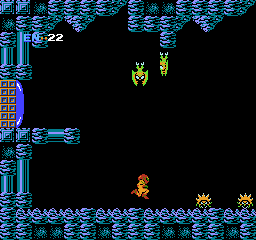
Metroid is an action-adventure video game franchise created by Nintendo, centered on the bounty hunter Samus Aran and her campaign against the Space Pirates and the parasitic Metroid creatures they seek to harness.16 Combining side-scrolling platforming with labyrinthine, nonlinear exploration in a science-fiction setting, the series is often ranked with Super Mario and The Legend of Zelda as one of Nintendo’s three foundational first-party franchises.13 The original game debuted in Japan in 1986 and has grown through more than a dozen entries across three decades, spanning 2D side-scrollers and 3D first-person adventures.314
Origins and the first game
In 1986, Nintendo designer Shigeru Miyamoto commissioned creators at Nintendo R&D1 and Intelligent Systems to build an action game that combined the side-scrolling platforming of Super Mario Bros. with the labyrinthine exploration of The Legend of Zelda.12 The game was produced by Gunpei Yokoi, whose R&D1 team sought to launch a franchise equal to Miyamoto’s.19 Yokoi assigned three men to the project: Makoto Kanoh created the characters and scenario, Hiroji Kiyotake designed Samus and the bosses Ridley, Kraid, and Mother Brain, and Yoshio Sakamoto directed.9

Metroid first appeared on the Famicom Disk System in Japan, released on August 6, 1986; a slightly simplified version reached North America for the Nintendo Entertainment System the following year without the Disk System’s features.913 The disk medium’s rewritable storage and 128K capacity allowed the game its three save slots, making a long adventure that could take hours to complete feasible.9 The plot casts the player as Samus Aran, dispatched to the planet Zebes to destroy the supercomputer Mother Brain and stop the Space Pirates from weaponizing the Metroids, life-draining alien creatures invulnerable to most conventional weapons.114
Exploration was the game’s central mechanic: despite its left-to-right scrolling format, the player’s first task is to move left to collect the Morph Ball, which lets Samus collapse into a sphere and roll through tight passages.19 Areas scrolled either horizontally or vertically but never both, and the world was built from a limited set of repeated pieces to conserve cartridge memory, a constraint that made careful mapping essential.13 Players progressed by finding weapons and power-ups, many of them required to reach new areas, in a design widely compared to that of The Legend of Zelda.313
The reveal and Alien’s influence
Director Yoshio Sakamoto cited Ridley Scott’s 1979 film Alien as a major source of inspiration, shaping creature and level design, the atmospheric music, and the twist that Samus is a woman — a parallel to Ellen Ripley as the true survivor of Alien.19 Sakamoto recalled that the idea arose mid-development when a staff member suggested it would be cool if the figure inside the suit turned out to be a woman.9 Elements of the film’s influence recur throughout: the Metroids function like facehuggers, Samus’s nemesis Ridley echoes a xenomorph, and the Chozo statues resemble the film’s precursor beings.1
Metroid concealed Samus’s gender throughout the first game, its instruction booklet referring to the hero as “he”.913 The ending changed with the player’s completion time, and finishing in under a certain span rewarded players with the reveal that the armored hero was a human woman; those who beat the game in two hours or less saw her remove her suit.19 CBR characterizes the reveal as partly a marketing decision, reflecting uncertainty at Nintendo that an action game could be carried by a female protagonist.1 The choice made Samus one of gaming’s earliest major female leads, and IGN has called her role probably the first major starring role for a woman in a video game.10 The mechanic of tying the ending to completion time also helped establish the practice of speedrunning.1
The soundtrack, composed by Hirokazu “Hip” Tanaka, stood apart from the upbeat music of contemporaneous 8-bit games as a moody, atmospheric score suited to the alien setting.6 Tanaka said he wanted players to feel as if they were encountering a living creature, blurring the distinction between music and sound effects.6
Sequels and the leap to 3D
A sequel did not arrive for five years.9 Metroid II: Return of Samus followed on the Game Boy in 1992, sending Samus to the Metroids’ home planet SR388 to exterminate the species; it retained the series’ exploration-intensive design and multiple endings tied to completion time.31410 Super Metroid reached the Super Nintendo Entertainment System in 1994 and is widely regarded as one of the greatest games ever made, using Mode 7 effects to bring its level designs to life.3 In it, the Metroid hatchling Samus brought back from SR388 is stolen by Ridley and taken to a rebuilt Space Pirate hideout on Zebes.14
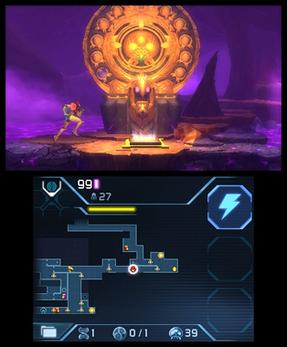
The series made the transition to three dimensions with Metroid Prime, a first-person GameCube game released in 2002.3 Although fans feared the shift from 2D side-scroller to first-person shooter would compromise the series, Prime and its sequel Metroid Prime 2: Echoes (2004) were received as worthwhile continuations.3 Reviewers noted that in the Prime games Samus’s arm-mounted cannon serves more as a means of progression than a weapon — missiles open doors, bombs clear blockages — and that the true obstacle is the vast terrain rather than the alien enemies.4 The Prime trilogy’s scan visor and atmospheric environmental design gave the environment an integral role rarely seen in other shooters.4

Later entries expanded the story and experimented with format: Metroid Fusion (2002) introduced the parasitic X and Metroid: Zero Mission (2004) remade the original with an added chapter.14 The series also produced spin-offs including Metroid Prime Pinball (2005), the multiplayer-focused Metroid Prime: Federation Force (2016), and the divisive Metroid: Other M.1419 Metroid: Samus Returns (2017) remade Metroid II for the Nintendo 3DS, and Metroid Dread launched on the Nintendo Switch on October 8, 2021, arriving 19 years after Metroid Fusion as a sequel in the timeline.1418 Metroid Prime 4: Beyond, developed by Retro Studios, was announced at E3 2017, restarted in January 2019, and re-unveiled in a Nintendo Direct on June 18, 2024.14
Legacy and the Metroidvania genre
Metroid’s fusion of platforming, nonlinear exploration, and upgrade-gated progression proved so influential that it gave its name to a subgenre: the Metroidvania, in which players navigate a sprawling labyrinth, collecting items across the map to unlock new areas.113 The term joins Metroid to Konami’s Castlevania, and commentators point in particular to Castlevania: Symphony of the Night, which abandoned the linear structure of earlier Castlevania games for an open, fully explorable castle.113 Other accounts trace the naming to the second Castlevania game, Simon’s Quest.13
The series’ design has since shaped a broad range of games — CBR cites Batman: Arkham Asylum, Carrion, and Doom Eternal as titles that adopt complex maps encouraging exploration for upgrades, artifacts, and world-building notes.1 Despite this influence and comparisons to Nintendo’s other flagship series, Metroid has often been regarded as the more overlooked of the company’s foundational franchises.13
Sources
Essay exploring Metroid's revolutionary impact on gaming, its design influences from Alien, and creation of the Metroidvania subgenre.
cbr.com · retrieved Jul 1, 2026Archive version of essay on Metroid as an overlooked Nintendo franchise that pioneered female protagonists and influenced game design.
web.archive.org · retrieved Jul 1, 2026GamePro feature ranking Metroid as one of the ten best video game franchises, highlighting its exploration and level design.
web.archive.org · retrieved Jul 1, 2026Edge Online review of Metroid Prime Trilogy collection for Wii, praising its environmental design and exploration-focused gameplay.
web.archive.org · retrieved Jul 1, 2026IGN's ranking of best 8-bit video game soundtracks, featuring Metroid's atmospheric and moody original score by Hirokazu Tanaka.
web.archive.org · retrieved Jul 1, 2026IGN's comprehensive history of Metroid covering its origins, development, influences, and evolution across multiple games.
web.archive.org · retrieved Jul 1, 2026IGN review of Metroid II: Return of Samus for Game Boy Color, praising its exploration-heavy design and atmospheric gameplay.
web.archive.org · retrieved Jul 1, 2026Personal retrospective essay examining the original Metroid's design, themes, and influence on exploration-based game design.
waltoriouswritesaboutgames.com · retrieved Jul 1, 2026Metroid game series database providing plot summaries for all major Metroid games from the original through recent entries.
shinesparkers.net · retrieved Jul 1, 2026Official Nintendo Metroid website directing players to the series games available on Nintendo Switch.
metroid.nintendo.com · retrieved Jul 1, 2026Metroid fan site covering game news, reviews, walkthroughs, and information about the series' history and releases.
metroid.retropixel.net · retrieved Jul 1, 2026TheGamer article organizing all Metroid games in chronological timeline order with game descriptions and context.
thegamer.com · retrieved Jul 1, 2026