M.U.L.E.
A four-player scramble to strike it rich on an alien colony, whose ruthless real-time auctions and supply-and-demand economics made it one of the earliest multiplayer classics — universally admired, rarely actually played.

M.U.L.E. is a 1983 multiplayer strategy game designed by Danielle Bunten Berry and developed by Ozark Softscape for Atari 8-bit computers, published by Electronic Arts as one of the company’s first five titles.34 Set on a distant colony world, the game drops four players onto a planet and gives them a fixed number of turns to amass the most wealth by claiming land, producing resources, and competing in tense real-time auctions.124 It combines turn-based colony-building with simulated supply-and-demand economics and direct, simultaneous player competition.12
The name is an acronym for the “Multiple Use Labor Element,” the labor robots players deploy to extract resources from the colony.12 The M.U.L.E.s themselves are mechanized versions of a beast of burden — the sterile hybrid offspring of a male donkey and a female horse, long valued as a hardy work animal.1416 Bunten Berry stated that part of the design was inspired by a section of Robert Heinlein’s Time Enough for Love, in which colonists of new planets used bio-engineered mules; programmer Jim Rushing also connected the name to the Reconstruction-era American promise of “forty acres and a mule”.310 Electronic Arts had pushed for the title “Moguls from Mars,” but relented after Ozark Softscape demonstrated how well “M.U.L.E.” looked on the title screen.3 The planet in the game, Irata, is “Atari” spelled backwards.10
Origins and design
M.U.L.E. grew directly out of Bunten Berry’s earlier work in multiplayer economic simulation. Her first game, the 1978 four-player business-management title Wheeler Dealers for the Apple II, introduced a real-time auction that she found unusually engaging, and its design was successively reworked in Cartels & Cutthroats and then M.U.L.E..3 For Wheeler Dealers, released through Speakeasy Software of Canada, she built her own four-player input devices because the Apple II had no such capability, and persuaded the publisher to package 500 copies in a printed box and sell them at $35 apiece when rival games sold for $15 in a Ziploc bag; only fifty copies sold, but the title launched her career.3 Bunten Berry, whose background was in operations research and systems simulation, considered these business-management designs the closest thing to game-building she could find in her earlier professional work.3
When Trip Hawkins approached her about writing a game for the fledgling Electronic Arts — he had wanted the rights to Cartels & Cutthroats but could not get them from its publisher, Strategic Simulations — she told him she could produce a better original, and shipped M.U.L.E. for the Atari 800 nine months later.310 Hawkins had played Cartels & Cutthroats and admired it, and the offer prompted Bunten Berry to leave her job as an industrial engineer and enter the games business full-time.10
The game was built around the real-time auction as its central activity, with the rest of the design devised to support it under two rules: that the underlying economic model be easy to describe, and that players enter decisions by “doing” rather than “telling”.3 It was balanced through exhaustive playtesting, with parties held several times a week at the rented Little Rock, Arkansas house that served as Ozark Softscape’s headquarters.310 The house, in a quiet residential neighborhood, gave each partner a bedroom for an office and doubled as a venue for focus-group parties, with multiple games set up in the den and living room for friends to play and critique.10
The four partners in Ozark Softscape were Bunten Berry, her brother Bill Bunten, Alan Watson, and Jim Rushing; Roy Glover composed the sound and music, and Joe Ybarra produced for EA.310 Within the group, Bunten Berry was the principal creative force and a capable programmer, Watson handled art and graphics with some programming, Rushing took charge of programming and implementation design — including the solo opponent — and Bill Bunten worked on creative design, gameplay tuning, and the company’s business affairs while keeping his full-time job as director of parks for the City of Little Rock.103 Rushing recalled the working title as “Planet Pioneers,” and noted that the game’s Wampus creature was a tribute to the BASIC game Hunt the Wumpus the team had played while learning to program.10
Bunten Berry designed M.U.L.E. to take advantage of the four joystick ports of the Atari 400 and 800, which allowed four players to compete simultaneously — a capability she considered essential to the game and one that later mainstream platforms lacked without special adapters.3 M.U.L.E. was the first game Ozark Softscape developed in a graphical environment, working on the Atari 800 rather than the Apple, aided by having a dedicated graphics artist on staff and by EA’s support for the move away from the visually spartan style of her earlier titles.3
Gameplay
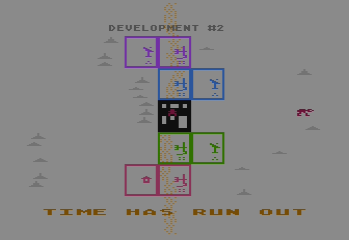
Four players are dropped onto the colony and given a set time to make their fortunes before the supply ship returns.12 M.U.L.E.s are labor robots used to extract resources from the distant planet, and much of play centers on claiming plots of land, installing M.U.L.E.s to produce commodities, and trading the results.12 There is no combat; competition takes the form of second-guessing rivals and faking them out during tense real-time auctions for resources.12 Random events repeatedly upend the economy — pirate raids, spikes in Crystite prices, pestilence disrupting food production, sunspots, planetquakes, and M.U.L.E.s that go crazy and run off.12
The Atari 800 version required a separate joystick for each player, while other versions had four players share a single joystick and keyboard in a hot-seat arrangement.12 The game was designed primarily for multiplayer, though a computer opponent — which speculates in resources, buys low and sells high, muscles rivals out of choice territories, floods the market to hold prices down, and rearranges its production to suit market conditions — provides a solid challenge until players master the underlying subtleties.12
Release and reception
M.U.L.E. was among the first five games Electronic Arts shipped on May 20, 1983, when the entire company — a few dozen people, average age around 25 or 26 — gathered in a South San Francisco warehouse to pack the boxes personally and load them onto UPS trucks.46 The games went to mom-and-pop video game stores, dedicated retail chains not yet existing, and staff celebrated the day with a barbecue and t-shirts reading “I survived: May 20 1983”.6 The lineup also included Archon: The Light and the Dark, Axis Assassin, Hard Hat Mack, and Worms?, and EA packaged the batch with the creators’ names on the front and album-style visual designs meant to evoke rock records.46

The game was developed for the Atari 400 and later ported to the Commodore 64 and the Nintendo Entertainment System 4; a Japanese MSX version was released in 1988 by Bullet Proof Software.9 EA described M.U.L.E. as one of the first hugely popular multiplayer video games and credited it with setting the stage for a generation of games to come.4
M.U.L.E. sold about 30,000 copies, which Bunten Berry regarded as respectable given that its home platform, the Atari 800, went out of production within months of release; the Commodore 64 port had poor solo capability but still sold well.3 Though a modest commercial performer, it was as widely distributed as Seven Cities of Gold, which sold five times as many copies, and it circulated hand to hand among players who copied it for friends.3 Bunten Berry recalled that by the end she retained only a few copy-protected disks she could not duplicate even for friends.3
Writing for IGN in 2000, critic Tom Chick likened M.U.L.E.’s reputation to that of Citizen Kane — universally praised yet rarely actually played — and observed that it “did not begin a genre” and spawned no army of clones, an original that resists description in the terms of later games.12 Chick praised the interface as remarkably sleek for a game shared on a single joystick, and singled out the “infectious” M.U.L.E. theme despite the era’s primitive graphics and PC-speaker sound.12
Bunten Berry, formerly known as Dan Bunten, was an industrial engineer by training — a 1974 graduate who had done mathematical modeling of urban systems for the National Science Foundation before entering the games business.312 She died of cancer in 1998, remaining widely regarded as a master of the multiplayer game whose designs — including Seven Cities of Gold, Modem Wars, and Global Conquest — predated the networked-multiplayer era touched off by Doom.312 Her later games grew from a lone-wolf effort into a coordinated team of programmers, artists, a sound and music person, a writer, and a director of playtesting, a shift that began as far back as Cartels & Cutthroats.3 According to Rushing, the rights to M.U.L.E. eventually passed to Bunten Berry’s estate after she bought out her partners’ interests in the property.10 A mobile-derived remake, M.U.L.E. Returns, was later produced by Comma 8 Studios and described by reviewers as a faithful revival of the classic supply-and-demand game.19
Sources
Interview with game designer Danielle Berry about her pioneering multiplayer games including M.U.L.E. and her career in game development.
dadgum.com · retrieved Jul 3, 2026Electronic Arts' history post commemorating the company's first game shipment on May 20, 1983, including titles like M.U.L.E. and Archon.
ea.com · retrieved Jul 3, 2026Polygon article about Electronic Arts' inaugural game release in 1983, featuring the first five titles shipped by the company.
polygon.com · retrieved Jul 3, 2026Game company database listing Bullet Proof Software's developed and published games across various platforms and years.
web.archive.org · retrieved Jul 3, 2026Interview with Jim Rushing about his work as a programmer and producer at Ozark Softscape on the game M.U.L.E.
web.archive.org · retrieved Jul 3, 2026PC retrospective review of the classic game M.U.L.E., discussing its innovative supply-and-demand gameplay and creator Danielle Bunten.
web.archive.org · retrieved Jul 3, 2026mule # mule mammal Written and fact-checked by Britannica Editors Encyclopaedia Britannica's editors oversee subject areas in which they have extensive knowledge, whether from years…
britannica.com · retrieved Jul 3, 2026Home / Blog / What is a mule? 13 things you didn’t know # What is a mule? 13 things you didn’t know Mules are…
workinganimals.org · retrieved Jul 3, 2026Steam store page for M.U.L.E. Returns, a modern remake of the classic 1983 resource management and supply-demand economics game.
store.steampowered.com · retrieved Jul 3, 2026