MUD
Born in a University of Essex computer room in the late 1970s, the text-based multi-user dungeon let strangers meet, fight, and build worlds entirely in prose — and seeded the lineage that led to the modern massively multiplayer game.
A multi-user dungeon, or MUD — also expanded as multi-user dimension or multi-user domain — is a multiplayer, real-time virtual world, usually text-based, in which multiple users connect to a shared server over a network and interact in a common environment described to them in prose.23 At the lowest level of commonality, a MUD is a virtual environment residing on a server to which any machine with remote login capability may establish a connection over the Internet, where the user creates a virtual icon to represent themselves and where multiple users interact in real time, in the manner of teleconferencing.2 Players typically read descriptions of rooms, objects, and other characters and act on the world by typing commands resembling natural language.2 MUDs combine elements of role-playing games, adventure gaming, and online chat within a single persistent space.5
Although most such environments have historically used a text-based interface only, a few expanded into graphics on X-terminals, and a very few — such as the Jupiter Project at Xerox PARC — worked to include real-time video and audio.2 The defining technical trait is persistence: the objects that make up the world are stored in a database, so the world stays the same after a shutdown and restart of the server, and what users perceive as a world is, in technical terms, simply a database.3
Academic study of MUDs has classically divided into two camps: ethnographic reports treating the MUD as a new frontier in social behavior, and technical reports examining it as a configuration of software and hardware.5 The MUD has been characterized as the latest expression of an ancient human desire to communicate within a shared imaginary space, providing in its networked form a set of virtual meeting places for the exchange of ideas and information.5
Origins
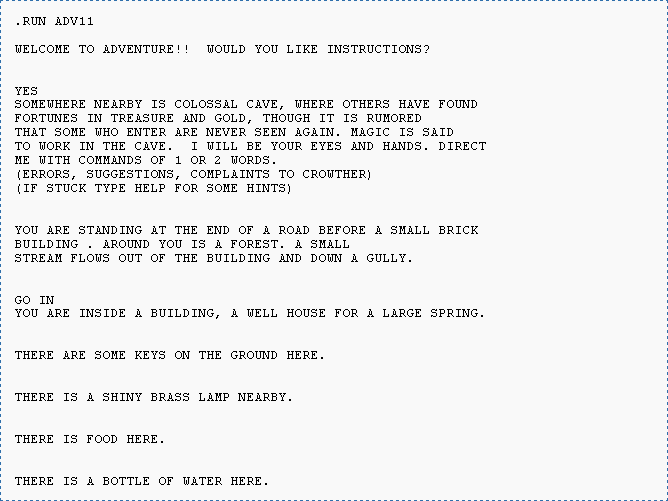
The original MUD was written in 1978–1979 by Roy Trubshaw and Richard Bartle at the University of Essex in England.521 The work began in 1978, and the system the two built — known as MUD1 — was the first multi-user virtual world.21 These early worlds were persistent, shared environments hosted inside university mainframes, where strangers could meet, fight, and build communities entirely through text, long before World of Warcraft, , or any 3D virtual world.21 Its creation set off what one later account called “an avalanche of varieties of the software,” written in numerous programming languages and spreading across university mainframes.5
Variants and the two schools
From MUD’s numerous offspring there came to be two distinct schools of use.5 The adventure-game MUDs generally retained the word “MUD” in their names — among them AberMUD, LPmud, DikuMud, and KMud — while the social-interaction MUDs adopted a variety of other acronyms, including MUSE, MOO, TinyMud, SMUG, TinyMuck, MUSH, and LambdaMOO.5 Most of the higher-level research on MUDs was conducted within this second group, where internal coding took place in interpreted languages supporting object orientation.5 The two schools also diverged technically: adventure MUDs were usually coded both externally and internally in C and C++ variants such as LPC (Lars Pensjö C), while the social MUDs tended to switch internally to interpreted, object-oriented languages.5 LambdaMOO, one of the best-known social environments, was originated by Pavel Curtis of Xerox PARC.5
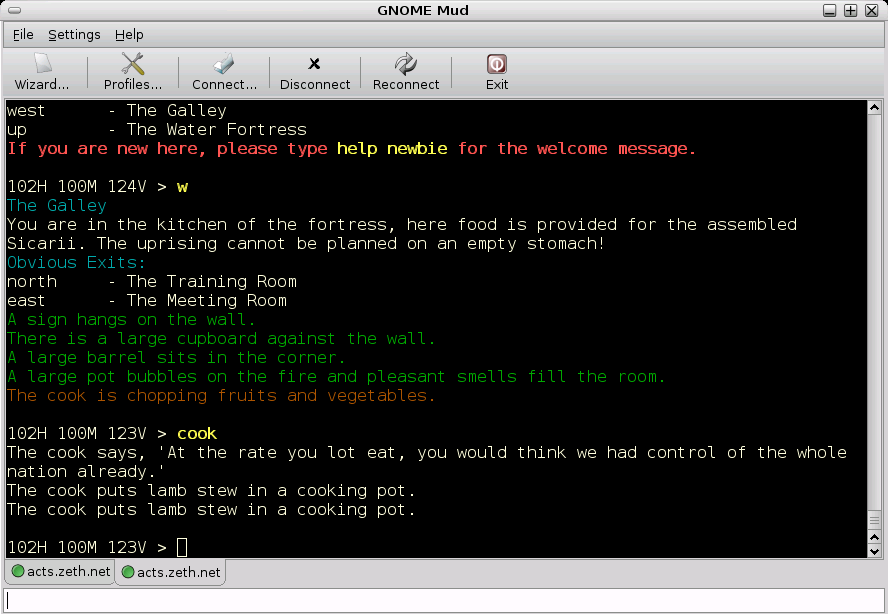
Notable adventure titles from the genre’s expansion include Avalon: The Legend Lives (1989), among the first persistent worlds to introduce player-run governments and political systems, and Discworld MUD (1991), which built a sophisticated economy and a regional weather system inside Terry Pratchett’s fictional universe.21 Software underpinning later MUDs continued to be developed into the 2000s; Dworkin’s Generic Driver (DGD), written by Felix A. Croes, served as a single-host, object-oriented foundation that academic researchers extended to build large, distributed persistent worlds.23 One such thesis, submitted to the University of Oslo in 2002, described a distributed persistent-world server built on DGD that preserved single-threaded programming semantics while spreading the world’s objects across multiple server nodes.23
Beyond games
The MUD framework was adopted for non-recreational purposes, including teaching (“virtual university”) and collaboration tools.35 Xerox’s Jupiter Project virtually modeled the company’s research laboratories in Palo Alto, California, and Birmingham, England, tying the two together so that researchers from either facility could exchange information and mingle socially in real time.5 At MIT, the MIRE Project — a multi-user information retrieval environment — used base MOO software to let astrophysicists hold meetings and retrieve and display data through Internet gopher facilities.5
PangaeaMud, developed as a 1993 master’s thesis at Miami University in Oxford, Ohio, by Erich Boring, repurposed free MUD software to create a friendly virtual environment for real-time geologic meetings and natural-language access to a database loaded from the Encyclopaedia of Mineralogy and other texts.5 It was created by modifying a freeware package written in C and the C++ variant LPC, with objects and classes designed for an object database and unused code stripped out to improve performance, and was made available on a machine known as phoenix.5 Boring described PangaeaMud as a hybrid that retained the C coding structure of the adventure MUDs while resembling the social MUDs in environment and function.5 He chose the form for his thesis because the MUD environment tied together nearly all of his coursework — programming, database design, information systems, data communication, data structures, and operating systems.5 A later project at the University of Southampton, presented in 2004, built a portal for interacting with context-aware ubiquitous systems on a MUD, using it as a spatial metaphor to reflect context in the physical world while collecting medical data from wearable devices.6
Legacy
MUDs are widely regarded as the ancestors of the massively multiplayer online role-playing game (MMORPG).23 Persistent worlds of the kind built for text MUDs evolved into the large, simultaneously shared worlds of MMORPGs such as EverQuest and World of Warcraft, whose servers store the state of the world in a database so that it persists across shutdowns and restarts.23 As these worlds grew beyond a certain size they could no longer run on a single server and required distribution, often combined with making several independent copies of the world so that two users could interact only if they were in the same copy.3 The persistence that distinguishes these worlds means the database survives a shutdown and restart of the server, including a reboot of the host computer.3
Richard Bartle has repeatedly addressed claims that MUD was not the first online role-playing game, noting that multi-user games on the University of Illinois’ PLATO system, such as Oubliette and Avatar, could be regarded as proto–virtual worlds depending on how far one stretches the definition.9 He maintained that the PLATO games lacked the persistence he considered necessary to qualify as virtual worlds, though pro-PLATO advocates disagreed.9 He argued that the PLATO games “had pretty well zero effect on the development of today’s virtual worlds,” and that if one follows the audit trail back from World of Warcraft, “you wind up at MUD”.9 By his account, virtual worlds were independently invented at least seven times — MUD, Sceptre of Goth, Avatar, Island of Kesmai, Aradath, Habitat, and Monster — by people unaware of one another’s work, with MUD the chronologically first of them.9 Bartle traced specific later worlds to specific text antecedents, holding that Dark Age of Camelot descends from Aradath and that Hero’s Journey has its roots ultimately in Sceptre of Goth.9
The degree of that influence has been debated. The game designer Raph Koster, addressing a dispute over Bartle’s claims, observed that the gameplay style of EverQuest or World of Warcraft is “obviously influenced by MUDs,” while another designer, Steve Danuser, proposed that MMOs “would have evolved anyway” and that no particular MUD had a profound influence on any given game.23 Koster noted that much of the leadership behind the major MMOs of his day still came from an “old guard” of designers and executives active in the mid-to-late 1990s.23
The term “MUD” carries unrelated meanings in other domains.13 In the United States it most commonly denotes a municipal utility district, a special governmental entity that provides water, sewer, and other utilities, particularly in areas not served by existing public utilities.1314 In Texas such districts are political subdivisions of the state overseen by the Texas Commission on Environmental Quality, authorized under Chapter 54 of the Texas Water Code adopted in 1971 to finance water, sewer, and storm-drainage infrastructure for new development.1416 In its ordinary English sense, “mud” denotes wet, soft earth — a slimy, sticky mixture of solid material with water — a word traced to Middle English and Middle Low German mudde.1718
Sources
A 2002 University of Oslo thesis on designing distributed persistent world servers for massively multiplayer online games using Dworkin's Generic Driver.
geir-hansen.com · retrieved Jun 29, 2026Archive.org copy of a 2002 University of Oslo thesis on distributed persistent world servers for massively multiplayer online games.
web.archive.org · retrieved Jun 29, 2026A 1993 Miami University technical report describing PangaeaMud, an object-oriented online geologic database tool using MUD technology.
web.archive.org · retrieved Jun 29, 2026A 2004 conference paper on using MUD-based portals to interact with context-aware ubiquitous systems for medical device monitoring.
web.archive.org · retrieved Jun 29, 2026A scientific research article on high-throughput characterization of platinum-supported catalysts for oxygen reduction reactions.
pubmed.ncbi.nlm.nih.gov · retrieved Jun 29, 2026An EBSCO research overview explaining Municipal Utility Districts as special governmental entities providing water, sewer, and utility services.
ebsco.com · retrieved Jun 29, 2026Information about Texas Municipal Utility Districts as political subdivisions managing water, sewer, and drainage infrastructure.
springcreekud.org · retrieved Jun 29, 2026Wells Branch Municipal Utility District website describing MUDs as Texas governmental entities providing water and wastewater services.
wellsbranchmud.com · retrieved Jun 29, 2026Merriam-Webster dictionary definitions of mud as wet earth or abusive remarks.
merriam-webster.com · retrieved Jun 29, 2026Dictionary.com entry defining mud as wet soft earth and providing related meanings and usage examples.
dictionary.com · retrieved Jun 29, 2026A history of text-based MUD games beginning with MUD1 in 1978 and their influence on modern online gaming.
ironrealms.com · retrieved Jun 29, 2026A blog post discussing the influence of early MUDs on modern MMORPGs like EverQuest and World of Warcraft.
raphkoster.com · retrieved Jun 29, 2026