Dragon Slayer
A warrior who lived, absurdly, inside the very maze he was meant to escape, hauling magic stones home one by one — the 1984 dungeon crawl that helped invent the action RPG in Japan.
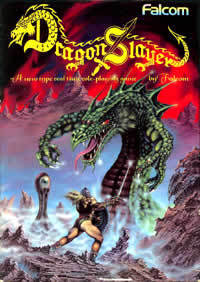
Dragon Slayer is a 1984 action role-playing game developed by Nihon Falcom and designed and programmed by Yoshio Kiya, widely cited as one of Japan’s first games in the genre.25 It was originally released for the PC-8801 in 1984 and became a major success in Japan, spawning a long-running line of loosely connected games that carried the Dragon Slayer name.132 The game was never released outside Japan, but its top-down presentation and puzzle-filled dungeons influenced later works, most notably the original The Legend of Zelda.132 Its box billed it as “a ‘new type’ of RPG,” and its Japanese catchphrase promised “an unprecedented, narcotically exhilarating game”.145
At the time of its release, most computer games in Japan were simple action or shooter titles, text-based adventures, or command-based dungeon crawlers derived from Wizardry, Ultima, and Rogue; against that backdrop, an action-driven RPG playable in real time was a genuine novelty.13 Contemporary Japanese sources described it as one of the earliest action RPGs, released the same year that Namco’s Tower of Druaga appeared in arcades, and it is now routinely listed as the pioneer or near-pioneer of the form.314
Gameplay
The player controls a warrior trapped in a dungeon who must find crowns and slay a dragon while beginning almost entirely defenseless.23 Both the hero and the enemies move through the maze one block at a time, so slowly that the action feels almost turn-based, and even the weakest enemy can kill a starting character in a single encounter.214 Combat is resolved by bumping into enemies and continuing to bump into them, watching both hit-point totals fall toward zero — a system shared with most early Falcom RPGs and later refined in Ys.214
The only means of growing stronger is to explore the dungeon, find power stones scattered through each level, and carry them back to the hero’s house — which, absurdly, sits inside the dungeon itself — where each stone slowly raises the Strength statistic.214 Even a single deposited stone transforms the early game, cutting the number of bumps needed to kill a starting enemy from dozens to three or four.14 Coins found on the landscape raise maximum hit points when returned home, and killing enemies grants experience that determines how much HP is regained on each visit.23 The player can hold only one item at a time, much as in the Atari VCS game Adventure from 1980, forcing constant dropping and retrieving and making the transport of stones extraordinarily time-consuming.2
Magic in the game is non-offensive, used to break down walls, warp through the dungeon, bring up a map, or save; all of it is powered by bottles strewn about the level.23 Other found items include a cross that protects the hero but prevents attacking, a ring that lets the player push blocks and even push the house itself, and keys that unlock treasure chests.23 Unlike many contemporaries, the levels are not randomly generated, so items always appear in the same locations.2 The maze wraps horizontally like Pac-Man, but Namco’s friendly enemy behavior is absent: every monster makes a straight beeline for the hero, and being caught between two of them in a narrow corridor is usually fatal.142 Enemies range from the conventional — bats, skeletons, zombies, mummies — to the bizarre, including dinosaurs, dismembered feet, television screens, and parody characters.25 Some enemies drain magic, experience, or strength rather than just life, and ghosts wander the maze stealing items and dropping them elsewhere.2
Origins and design
Dragon Slayer was not Nihon Falcom’s first game to be labeled an RPG; Kiya had previously worked on Panorama Toh, a 1983 PC-8801 title that Falcom itself called an RPG despite lacking stats or level-ups.7 That earlier game already gestured toward real-time combat, with enemies that rushed the player and had to be struck in time, which one commentator read as Falcom “getting there eventually” on the way to the action RPG.7 Kiya cited the Apple II game Coops and Robbers by Sirius Software as an inspiration for Dragon Slayer, a plausible link given that Falcom was an Apple retailer during that period.521 The block-pushing mechanic strongly resembles the puzzle game Sokoban, which had appeared on the PC-8801 only a couple of years earlier, and it turns the dungeon into a shifting spatial puzzle in which walls can be pushed to open new paths to otherwise unreachable items.14
The original was released on the PC-8801 in October 1984, and used a 640×200 eight-color screen mode with PSG sound.5 Ports followed to a range of Japanese systems including the FM-7, X1, MSX, and others.52 A year later Square published an MSX port based on the second version of the PC-8801 original, one of that company’s earliest titles, featuring remixed level designs but otherwise the same experience.314 Epoch released a Game Boy port in 1991 whose monochrome graphics were arguably cleaner than either home-computer version but whose movement was so slow as to make it nearly unplayable.3 The game later appeared on the Falcom Classics compilation for the Saturn alongside Xanadu and Ys, in a version tuned to be more forgiving — the player begins already equipped with a sword, a key, and a power stone.3
The Dragon Slayer series
The Dragon Slayer name became a label under which many later Falcom games were released, all programmed or directed by Kiya and sharing much of the same staff, though most bore little resemblance to one another in plot or genre.216 There is no continuing story across the games, and their genres vary widely, the only firm connection being the recurring staff and occasional recurring elements such as the legendary Dragon Slayer sword.16 The line is generally counted as eight numbered entries: the original Dragon Slayer, Xanadu, Romancia, Drasle Family — released in the West as Legacy of the Wizard — Sorcerian, The Legend of Heroes, Lord Monarch, and The Legend of Xanadu.318
Xanadu, released in 1985, sold more than 400,000 copies and became one of the most successful PC games in Japan; it shared staff with the original but replaced almost everything about its design, becoming a side-scrolling dungeon crawler with a Karma statistic and a hunt for the lost Dragon Slayer sword.1 Later entries diverged further: Sorcerian was a side-scrolling action RPG with player-created characters and music by Yuzo Koshiro, while Lord Monarch became a real-time strategy game.1618 The Xanadu strand itself spun off Faxanadu — a portmanteau of Famicom and Xanadu — and, in 2005, the standalone hack-and-slash Xanadu Next, in which the Dragon Slayer sword remains the key item.16
Several of these sub-series went on to eclipse the original. The Legend of Heroes, first released in 1989 for the PC-8801 as the sixth Dragon Slayer entry, spun off into the Trails series that became one of Falcom’s central franchises alongside Ys.1320 Its earliest Western release came only on the TurboGrafx-CD, a version with CD-quality sound and voice acting that reached few players, leaving the series largely Japan-exclusive through the 1990s.20 In March 2026, as part of its 45th-anniversary celebrations, Falcom announced that it was reviving the dormant Dragon Slayer franchise more than 40 years after the first game launched, though it gave no release date or details.13
Legacy
Dragon Slayer is frequently grouped with T&E Soft’s Hydlide and Xtalsoft’s Mugen no Shinzou as among the most influential and important early Japanese action RPGs, laying foundations for later series including Ys and The Legend of Zelda.2 Its “grind” of building strength through repetition, its bump combat, and its top-down puzzle dungeons shaped Falcom’s own output for years, however indirectly.132 Later commentators note that the game is exceedingly difficult to play today — movement is choppy, the maze offers little navigational logic, and there is scant sense of reward — but that its scope and difficulty were part of its appeal in 1984, when simply inhabiting a small figure on a screen was reward enough.214
Sources
Detailed review of Xanadu, an important early Japanese side-scrolling dungeon-crawling RPG and sequel in Falcom's Dragon Slayer series.
hardcoregaming101.net · retrieved Jul 4, 2026Analysis of Dragon Slayer, one of Japan's first action RPGs from 1984 that influenced major games like Zelda and established the action-RPG genre.
hardcoregaming101.net · retrieved Jul 4, 2026Archived review of Dragon Slayer covering gameplay mechanics, combat system, and the series' influence on subsequent action-RPG development.
web.archive.org · retrieved Jul 4, 2026Database catalog entry for Dragon Slayer listing platform information and release versions.
fm-7.com · retrieved Jul 4, 2026Blog post about Panorama Toh, examining Falcom's proto-RPG that predated Dragon Slayer with hex-grid exploration and early action mechanics.
blog.hardcoregaming101.net · retrieved Jul 4, 2026Polygon article announcing Falcom's revival of the Dragon Slayer franchise after 40 years and discussing the original game's historical influence on RPGs.
polygon.com · retrieved Jul 4, 2026Critical retrospective examining whether Dragon Slayer remains playable today despite its 1984 release and archaic game design.
gamesfromtheblackhole.wordpress.com · retrieved Jul 4, 2026Overview of the entire Dragon Slayer series detailing each numbered entry and its gameplay style across multiple decades.
aaltomies.wordpress.com · retrieved Jul 4, 2026HardcoreGaming101 series hub page with links to articles covering all major Dragon Slayer franchise installments.
hardcoregaming101.net · retrieved Jul 4, 2026YouTube video retrospective analyzing Dragon Slayer: The Legend of Heroes as an underrated JRPG classic comparable to Final Fantasy and Dragon Quest.
youtube.com · retrieved Jul 4, 2026Reddit discussion noting that Dragon Slayer's design was influenced by Apple II games due to Falcom's status as an Apple retailer.
reddit.com · retrieved Jul 4, 2026