Dragon Quest (Series)
The Japanese role-playing series that turned slimes, level grinding, and a knight’s lonely march across Alefgard into a national institution — and, in doing so, gave the JRPG its founding template.
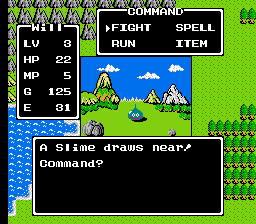
Dragon Quest is a Japanese role-playing video game franchise created by Yuji Horii and published by Enix, later Square Enix, for a variety of platforms.10 Its first installment, released in Japan in 1986 and localized in North America as Dragon Warrior because of copyright issues, is widely credited with establishing the template that Japanese RPGs have followed ever since.148 The series took Japan by storm, inspired dozens of imitators — including its principal rival, Final Fantasy — and remains one of the most important franchises in the medium.17 Domestically it has consistently outsold its rivals in Japan while attracting a comparatively muted response in the West, where the series was long known as Dragon Warrior.113
Origins and design
The original Dragon Quest was assembled from elements of earlier Western computer role-playing games.1 Horii combined the overhead, top-down movement of the Ultima series with the first-person, random battles of Wizardry, and in doing so effectively created the Japanese RPG subgenre.17 The creators drew directly on Wizardry I: Proving Grounds of the Mad Overlord of 1981, among other American computer RPGs, for its first-person combat presentation.1920 Those Western antecedents were themselves heavily rooted in the tabletop conventions of Dungeons & Dragons.1
The game gave the player a lone knight charged with retrieving a stolen sacred artifact — the Sphere of Light — from the evil Dragonlord and rescuing a princess in the kingdom of Alefgard, a young hero through whose veins flowed the blood of the legendary Erdrick (localized as “Loto”).11215 Its battles were one-on-one duels presented from the first person, offering four options: fight, run, cast a spell, or use an item.8 The design relied heavily on grinding: physical barriers to progress barely existed, and the main obstacle was the hero’s need to accumulate levels and equipment to survive.4 The whole game contained precisely one save point, reached by returning to the castle and speaking to the king, reinforcing the notion of the castle as a home base.4 Interaction was mediated by a menu of commands — Talk, opening doors, opening chests, climbing stairs — a cumbersome convention that persisted in the series as late as 2000’s Dragon Quest VII.4
Two collaborators gave the series its lasting identity. Character and monster designs came from Akira Toriyama, the manga artist behind Dr. Slump and Dragon Ball, whose artwork lent the otherwise standard designs of Western RPGs distinctive appeal.115 The score was composed by the classically trained Koichi Sugiyama, who had previously written background music for commercials; his rousing main theme became so familiar in Japan that commentators likened it to a national anthem.115
Growth of the series
Commercial success brought a rapid succession of sequels. Dragon Quest II (1987) added a longer quest, more items and spells, and — for the first time — additional party members, set one hundred years after the original in the same world.1713 Dragon Quest III (1988) introduced several character classes such as warrior, mage, cleric, and jester, and was set as a prehistory to the first two games, forming with them the “Erdrick Trilogy”.1512 Dragon Quest IV (1990) told a multi-chapter adventure focused on different characters in turn.116 Each sold enormously in Japan and cemented the franchise as one of the nation’s most popular.1

Two further installments followed on the Super Famicom, both adding greater narrative depth and character customization; Dragon Quest V (1992) and Dragon Quest VI (1995) were not released in the West at the time.11316 Dragon Quest VII (2000) sold in the millions in Japan despite its comparatively modest low-budget graphics.17 Dragon Quest VIII: Journey of the Cursed King (2004) introduced cel-shaded, manga-style graphics and full voice acting that finally rivaled Final Fantasy’s production values.113 Dragon Quest IX: Sentinels of the Starry Skies, released for the Nintendo DS, returned to a create-your-own-party structure with extensive job customization and multiplayer.613 Dragon Quest X was an MMORPG that remained in Japan.1316 Dragon Quest XI: Echoes of an Elusive Age (2017) was later released internationally, its Definitive Edition arriving on Steam on December 4, 2020.1416
A defining trait of the series has been its consistency: all mainline games take place in a European-style medieval world and retain the same key creative staff — Horii, Toriyama, and Sugiyama — so that the storytelling, characters, battle system, and musical style remain broadly stable across decades, a marked contrast to Final Fantasy, which reinvented itself with each iteration.17 The franchise has expanded into spin-offs ranging from the monster-catching Dragon Quest Monsters and the Minecraft-like Dragon Quest Builders to the action title Dragon Quest Heroes.1117
Reception and legacy
Dragon Quest was published in North America by Nintendo of America in 1989, three years after its Japanese debut, complete with a mini-strategy guide meant to introduce newcomers to role-playing.17 American players, however, largely ignored it: its graphics and sound seemed primitive, its interface unwieldy, and its slow-paced turn-based combat lacked the action of The Legend of Zelda.17 Nintendo overestimated demand and gave away unsold copies to Nintendo Power subscribers, which paradoxically spread awareness among NES owners.17 The series was quickly eclipsed in America by Final Fantasy, and later entries arrived too late to compete with 16-bit rivals, making the American Dragon Warrior III and IV among the most sought-after NES cartridges.17
The first game created the template that Japanese RPGs follow to this day, its influence enduring through its sequels and mirrored by the descendants of its imitators.4 It directly inspired Final Fantasy, which in turn shaped a broad lineage of console RPGs.121 The party-and-classes structure refined in Dragon Quest III, with its warrior, mage, and cleric roles, exemplified the number-crunching, turn-based standard that later JRPGs inherited.516
The series has remained continuously available through ports and remakes across MSX, the Super Famicom, Game Boy Color, mobile phones, and the Nintendo Switch, where the original Dragon Quest was released on September 27, 2019.15 Square Enix has since produced HD-2D remakes: a Dragon Quest III HD-2D Remake and a combined Dragon Quest I & II HD-2D Remake presenting the Erdrick Trilogy.1112 Fans and critics generally rank Dragon Quest V, with its life-spanning story, and Dragon Quest XI among the strongest entries.1316
Sources
In-depth history of Dragon Quest franchise, covering its creation, rise to popularity in Japan, and limited Western reception.
gamedeveloper.com · retrieved Jul 3, 2026Analysis of design lessons and game mechanics from the original Dragon Quest, examining exploration and leveling systems.
web.archive.org · retrieved Jul 3, 2026GameSpot review of Dragon Warrior III for Game Boy Color, praising its traditional turn-based RPG gameplay for experienced players.
web.archive.org · retrieved Jul 3, 2026Nintendo president Satoru Iwata interviews Dragon Quest creator Yuji Horii about the game's creation and franchise history.
web.archive.org · retrieved Jul 3, 2026Detailed history of Dragon Quest series, its origins, design innovations, and impact on Japanese RPG development.
web.archive.org · retrieved Jul 3, 2026Retrospective review of original Dragon Warrior, analyzing its battle system, interface, and historical significance to RPG genre.
web.archive.org · retrieved Jul 3, 2026Dragon Quest Fandom wiki overview identifying the franchise as a major Japanese media property by Square Enix.
dragonquest.fandom.com · retrieved Jul 3, 2026visit site visit site visit site visit site visit site visit site visit site visit site visit site visit site visit site visit site visit…
dragonquest.square-enix-games.com · retrieved Jul 3, 2026Official Square Enix page for Dragon Quest I & II HD-2D Remake, featuring stories and gameplay details of both games.
dragonquest.square-enix-games.com · retrieved Jul 3, 2026Ranked list of mainline Dragon Quest games with detailed reviews of each entry's strengths and weaknesses.
infinityretro.com · retrieved Jul 3, 2026Steam store page for Dragon Quest XI S, the definitive edition with orchestral soundtrack and additional content.
store.steampowered.com · retrieved Jul 3, 2026Nintendo Switch storefront listing for the original Dragon Quest with updated controls and story description.
nintendo.com · retrieved Jul 3, 2026Shacknews ranking of major Dragon Quest numbered titles with recommendations for best ways to play each game.
shacknews.com · retrieved Jul 3, 2026Comprehensive guide ranking Dragon Quest games available on Nintendo platforms, including remakes and spin-offs.
nintendolife.com · retrieved Jul 3, 2026Facebook discussion mentioning inspirations for Dragon Quest from earlier games like Wizardry and Ultima.
facebook.com · retrieved Jul 3, 2026Dragon Quest Fandom wiki entry noting inspiration from American computer RPGs Wizardry and earlier titles.
dragonquest.fandom.com · retrieved Jul 3, 2026Reddit discussion tracing Dragon Quest's influence on Final Fantasy and subsequent RPG franchises.
reddit.com · retrieved Jul 3, 2026