Donkey Kong (game)
The barrel-dodging climb that rescued a near-bankrupt playing-card company, invented the platformer, and turned a carpenter named Jumpman into Mario.
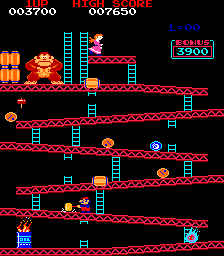
Donkey Kong is an arcade video game released by Nintendo in 1981, an early example of the platform genre in which the player guides a character across a series of platforms while jumping over and dodging obstacles.2 The player assumes the role of Jumpman, a carpenter who must rescue his girlfriend — called Pauline in the West and Lady in Japan — from a giant ape named Donkey Kong, who has carried her to the top of a construction site.12 It was the first video game to build gameplay around a narrative premise, and it introduced the platformer, a genre that would become a staple of the medium.1 The game reversed the sagging fortunes of Nintendo, launched the career of designer Shigeru Miyamoto, and gave rise to Mario, among the most recognizable characters in gaming.1
Background and creation
Nintendo had been founded in Kyoto in 1889 as a maker of hand-painted hanafuda playing cards, and turned toward toys and games as the card market faltered in the 1960s.1 In the early 1970s the company took notice of the growing popularity of video games in the United States, where Atari had released the first commercially successful arcade game, Pong, in 1972, the same year Magnavox unveiled the first home console, the Odyssey; Nintendo acquired the Japanese distribution rights to the Odyssey and began developing its own games for both markets.1 By the late 1970s it had produced its first home consoles and several coin-operated titles, but rivals Taito and Namco were reaping large profits in America with games such as Space Invaders and Pac-Man.1 Seeking a foothold in that lucrative market, Nintendo ordered three thousand cabinets of its shooting game Radar Scope, a title reminiscent of Space Invaders.18 The game was a commercial disaster, selling roughly one thousand units and leaving Nintendo sitting on some two thousand unsold cabinets in America — a potentially crippling blow to its American operations.18
To salvage the investment, Nintendo decided to replace the internal components of the unsold cabinets with a new game, and — with its senior designers occupied — handed the task to Shigeru Miyamoto, a staff artist who had drawn the artwork for Radar Scope and other cabinets but had never developed a game.1 Miyamoto was paired with the veteran designer Gunpei Yokoi, who handled the technical work while Miyamoto conceived the story and characters.1
The project began as a licensed game based on the comic strip Popeye, with Popeye as the hero, Olive Oyl as the love interest, and Bluto as the villain, but the plan collapsed when Nintendo could not secure the rights.16 Miyamoto kept the outline and substituted original creations: a middle-aged carpenter he called Jumpman — a nod to Pac-Man — and a giant ape whose role took over the one intended for Bluto.16 Miyamoto said he chose “Donkey” to convey the character’s stupidity and “Kong” as a generic Japanese term for large apes, though accounts of the naming differ; court testimony in the later Universal lawsuit indicated that export manager Shinichi Todori coined the first name while trying to translate the Japanese word tonma, with final approval given by Gunpei Yokoi or Hiroshi Yamauchi.4 Court documents from that suit list a long roster of rejected alternatives, among them “Funny Kong,” “Kong the Kong,” “Jack Kong,” “Funky Kong,” “Steel Kong,” “Kong Boy,” and “Kong Holiday”.4 Miyamoto has also credited the Beauty and the Beast fairy tale as an inspiration 4, while the game’s stage designs have been linked to earlier climbing games such as Space Panic and Crazy Climber.9 Most arcade games of the era featured space battles, auto racing, or maze navigation; Miyamoto instead gave Donkey Kong distinctive characters and a comic-strip storyline in which the ape falls for the heroine and carries her off, with Jumpman pursuing across scaffolding to progressively harder levels.1
Gameplay
The game unfolds across four single-screen stages, each representing a portion of the structure Donkey Kong has climbed — labeled 25, 50, 75, and 100 meters.2 The first stage sends the player up crooked girders and ladders while jumping over or hammering barrels and oil drums the ape hurls down; the second is a five-story arrangement of conveyor belts carrying cement pans; the third involves riding elevators past bouncing springs; and the fourth requires removing eight rivets from the platforms.2 Points are awarded for leaping over obstacles, destroying objects with a hammer power-up, collecting items such as hats, parasols, and purses presumed to belong to Pauline, removing rivets, and completing stages against a decreasing bonus counter.2 The player begins with three lives, with a bonus life at 7,000 points and the total adjustable via DIP switches, and loses a life on contact with the ape or an enemy object, a long fall, or the bonus counter reaching zero; the game ends when all lives are lost.2
Following 1980’s Space Panic, Donkey Kong is one of the earliest platform games, predating the coining of the term — the U.S. gaming press used “climbing game” for titles built on platforms and ladders — and as the first platform game to feature jumping it set the template for the genre by requiring players to leap between gaps and over obstacles and enemies.2 With its four distinct stages it was among the most complex arcade games of its time, and one of the first to offer multiple stages, following titles such as 1980’s Phoenix and 1981’s Gorf and Scramble.2 According to the critic Nick Paumgarten, games before Donkey Kong had been built by engineers and programmers with little regard for narrative or graphical playfulness.8
Release, reception, and legal dispute
Donkey Kong debuted in the summer of 1981 — Nintendo of America introduced it in arcades on June 2 of that year.8 The revamped Radar Scope cabinets sold quickly, and Nintendo ordered thousands more; within a year the company had sold about sixty thousand cabinets and earned a profit exceeding $100 million, with total sales reaching roughly 132,000 cabinets.1 Its success established Nintendo as a major player in the American market pioneered by Atari, and helped save the company’s American operations.18 The game arrived amid a wider public anxiety about arcades: by 1983 video games were being blamed for increasing crime and school absenteeism and for a purported ailment called “video wrist,” even as the industry argued they promoted dexterity and quick thinking.8
In 1982, Universal City Studios sued Nintendo and Coleco, claiming the name Donkey Kong infringed its rights to King Kong, the giant ape of the 1933 film and its 1976 remake.1611 Coleco settled, agreeing to pay Universal three percent of its Donkey Kong net sales, but Nintendo, represented by attorney John Kirby, fought the claim rather than settle.16 Universal filed its suit on June 29, 1982; the next day Nintendo released the arcade sequel Donkey Kong Jr..6 The court ruled in Nintendo’s favor, finding the Kong name in the public domain and Donkey Kong at most a parody of King Kong.16
Influence on other games
Donkey Kong is credited with introducing the platform genre and setting its template, popularizing mechanics such as jumping over gaps and obstacles that would become staples of subsequent games.112 Many of the features it popularized — including platforming, the jump mechanic, the linking of story and gameplay, and the use of multiple levels within a single game — contributed to the wider evolution of video games.12 Contemporaries described its narrative-driven design as a departure from an era dominated by space battles, auto racing, and maze games, and it was among the first titles to give distinctive characters and a comic-strip storyline to arcade play.1
The game’s hammer power-up, which temporarily lets the player destroy oncoming obstacles, was likened to the Power Pellet mechanic of Pac-Man, which similarly grants a brief ability to defeat pursuing enemies.12 Its own design in turn drew on earlier climbing games such as Crazy Climber and Space Panic, adapting the act of ascending a structure while dodging falling hazards into a jumping-based format.139
Donkey Kong also launched the career of Shigeru Miyamoto and gave rise to Mario, one of the most iconic characters in video game history, whose subsequent games became among the best-selling in the medium and anchored an enduring franchise.112 Following the game’s success, Nintendo secured the license to Popeye that had originally been denied, and Miyamoto co-developed an arcade Popeye game released in 1982.12
Legacy and ports
Donkey Kong was inducted into the World Video Game Hall of Fame in 2017.1 It spawned two arcade sequels, Donkey Kong Jr. (1982) and Donkey Kong 3 (1983), neither of which matched the original’s success; Donkey Kong Jr., the first game developed entirely in-house at Nintendo, reversed the premise, casting the ape’s son as hero against a captor Mario, while Donkey Kong 3 switched to a shooter starring Stanley the Exterminator.156 The game was ported widely, including a version for Nintendo’s Nintendo Entertainment System (NES) and a 1982 Game & Watch handheld, and was licensed to Coleco for its home consoles.56
Its most lasting product was Jumpman himself, reimagined as a plumber and renamed Mario — reportedly because staff at Nintendo’s American offices thought he resembled their Italian landlord, whose name was Mario — and introduced in North America with Super Mario Bros. on the Nintendo Entertainment System (NES) in 1985.1 Designed by Miyamoto, Super Mario Bros. became one of the best-selling games in history and anchored a franchise of sequels and spinoffs, while Miyamoto went on to create The Legend of Zelda series.1 The ape, meanwhile, anchored his own franchise; the 1994 SNES game Donkey Kong Country, developed by Rare, reinvented the character as a heroic protagonist living on Donkey Kong Island and established that the original Donkey Kong had become the elderly Cranky Kong.47 The original arcade game has since been reissued through Nintendo’s Arcade Archives series on Nintendo Switch, packaging its early, later, and international versions together and adding adjustable difficulty and online high-score leaderboards.3
Sources
EBSCO research article on Donkey Kong arcade game, covering its 1981 release, innovation in platform gaming, and impact on Nintendo's success.
ebsco.com · retrieved Jul 6, 2026RetroGames.cz emulator page offering playable NES version of Donkey Kong with game information and control instructions.
retrogames.cz · retrieved Jul 6, 2026Nintendo Store product page for Arcade Archives Donkey Kong on Nintendo Switch with game features and compatibility details.
nintendo.com · retrieved Jul 6, 2026Mario Wiki character article on Donkey Kong covering his creation, character evolution, and appearances across franchises.
mariowiki.com · retrieved Jul 6, 2026Comprehensive chronological list of all Donkey Kong games released across Nintendo platforms from 1981 to present.
nintendo.fandom.com · retrieved Jul 6, 2026YouTube documentary video tracing Donkey Kong's complete history from 1981 to 2023 and its role in Nintendo's development.
youtube.com · retrieved Jul 6, 2026Classic Gaming website detailing Donkey Kong's creation history, gameplay mechanics, and evolution through sequels and franchise expansions.
classicgaming.cc · retrieved Jul 6, 2026TIME magazine article on how Donkey Kong and Mario changed video gaming history and influenced the industry.
time.com · retrieved Jul 6, 2026Spotify podcast episode excerpt discussing Donkey Kong's inspirations from games like Crazy Climber and Space Panic.
open.spotify.com · retrieved Jul 6, 2026Personal blog post examining Donkey Kong's inspiration from the King Kong film franchise.
alexbass.me · retrieved Jul 6, 2026Blog post detailing the creation and gameplay of Nintendo's 1981 Donkey Kong arcade game by designer Shigeru Miyamoto.
ejunkieblog.com · retrieved Jul 6, 2026Translated 1996 technical article examining the programming and development challenges behind the original Donkey Kong arcade game.
shmuplations.com · retrieved Jul 6, 2026