Donkey Kong
A carpenter’s barrel-throwing pet gorilla who began as a video-game villain in 1981 and was reinvented, thirteen years later, as a necktie-wearing hero defending his banana hoard.
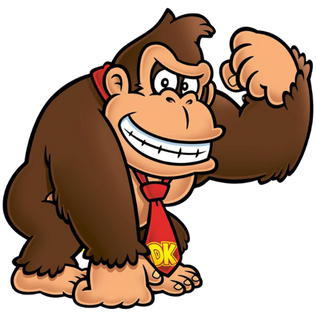
Donkey Kong, often abbreviated DK, is a powerful, carefree gorilla-based Kong who is the titular protagonist of the Donkey Kong franchise and a major character in the Super Mario franchise.13 Created by the video game designer , he made his debut in the Donkey Kong arcade game in 1981 as ‘s nemesis.13 In his original incarnation he was a villainous or confused ape of unequaled strength, while the Donkey Kong Country series of 1994 onward reimagined him as a heroic protagonist living on Donkey Kong Island as leader and protector of the Kong family.13
In the 1981 arcade original, Nintendo—then a toymaker barely established in the Japanese market and preparing to enter America—repurposed unpopular arcade cabinets to house the game.37 The game was created by the young artist Miyamoto under the supervision of Gunpei Yokoi, the designer who would later build the Game Boy.37 The simple narrative followed a carpenter’s pet gorilla who steals the workman’s girlfriend, introducing an actual plot to arcade gaming.3 The game is widely credited with inventing the platformer, and although Donkey Kong’s name was on the marquee, it was the player character Jumpman—soon renamed Mario—who became the breakout star, pushing DK into the background.37 Its lasting appeal rested on a compelling narrative hook, memorable music, and colorful, cartoony graphics, and the massive success made the stubborn ape a constant in Nintendo’s pantheon of franchises.311
Naming and the King Kong lawsuit
Miyamoto chose the name “Donkey” deliberately to reference the stubborn or stupid nature of the ape, rather than as a mistranslation of “Monkey Kong,” a commonly held belief that has been disproven.3713 “Kong” was treated as a generic term for large apes in Japan.13 Miyamoto was later told by Nintendo of America staff that “donkey” was not a synonym for “idiot” in English, but he chose to keep the name because he liked it.13 This account is complicated by his deposition in Universal City Studios, Inc. v. Nintendo Co., Ltd., in which he stated that his proposals for the first name were rejected and that he did not know who devised it; export manager Shinichi Todori testified that he produced the name while trying to translate the Japanese word tonma into English.13 A range of other names was considered before “Donkey Kong” was settled upon, including “Funky Kong,” “Jack Kong,” “Mr. Kong,” and “Kong Holiday,” recorded in court documents.13

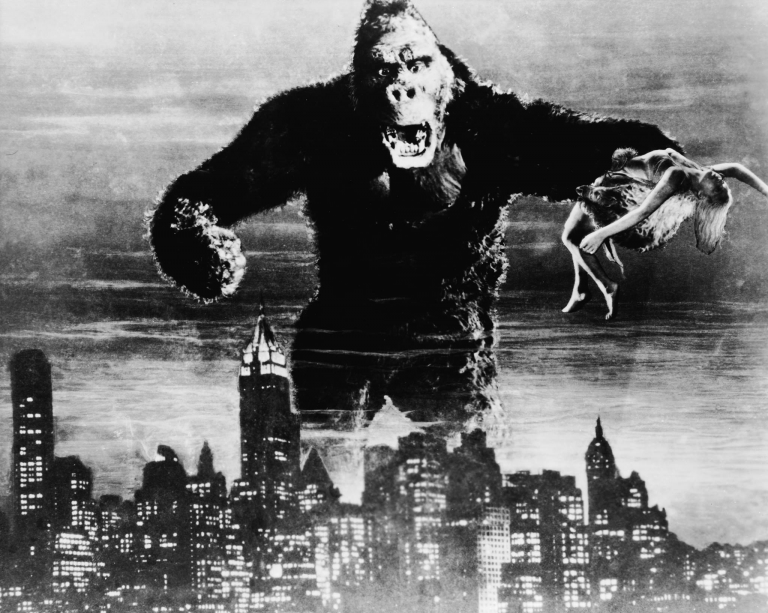
The character’s surname brought Nintendo into conflict with Universal Studios, which claimed the game infringed its King Kong copyright in both plot and title.720 The movie’s cultural reach was such that the appearance of a gorilla in any medium routinely prompted a reference to the 1933 film, whether quoting its closing line (“It was beauty killed the beast”) or recreating its Empire State Building climax.20 After Nintendo’s legal team proved that Universal did not even possess the rights to King Kong, the court sided with Nintendo—a significant victory on its path to expansion in the United States.7 The Donkey Kong Jungle Action Special records Miyamoto’s claim that the character was inspired by the Beauty and the Beast fairy tale, and Donkey Kong took over the antagonist role originally intended for Bluto in a scrapped Popeye arcade game.13
Arcade sequels and disappearance
The first arcade machine reached the United States in August 1981, when Nintendo of America placed it in a Seattle bar called The Spot Tavern.46 The 1982 sequel Donkey Kong Jr. inverted the roles, casting Mario as the whip-wielding jailer and handing the hero role to DK’s previously unknown son, who sets out to rescue his caged father—a risk with the company mascot that Nintendo would not take again.711 Donkey Kong 3 abandoned platforming for a Galaga-styled shooter in which the exterminator Stanley the Bugman fends off the ape with bug spray in a greenhouse.715 After this trilogy Donkey Kong all but vanished, appearing mainly in arcade ports and the occasional cameo for roughly a decade, with a Return of Donkey Kong for the NES announced but never shown.27 Junior, rather than his father, oddly joined the roster of the first Super Mario Kart on the SNES.7
Donkey Kong Country and reinvention
Donkey Kong returned in 1994, first in a Game Boy remake of the arcade original and then in Donkey Kong Country, developed by the British studio Rare.27 The 1994 Game Boy game introduced his red necktie bearing the white letters “DK,” and Donkey Kong Country gave him a new heroic personality, voice, and purpose as he pursues his stolen banana hoard across a garden paradise.713 Facing the looming threat of Sony’s PlayStation and an aging Super NES, Nintendo—a company that began as a playing-card manufacturer—used the game as a technological bluff.2 Rare rendered pre-calculated computer-generated graphics into flat bitmap tiles, eschewing the Super NES’s built-in graphical modes and creating the illusion of an advanced 3D-capable system without any special hardware.2 The trick depended on the public’s general inexperience with 3D graphics in 1994, and it worked, convincing players that the Super NES could still produce dazzling visuals and that next-generation consoles were not yet needed.27 At heart the game remained a fairly standard platformer, with Kong and his sidekick Diddy able to run, jump, ground-slap, and roll into foes like Sonic, but its craftsmanship and consistent, seamless world set it apart from later imitators.2
The new design, by Kevin Bayliss, drew on the Battletoads, particularly their sunken eyes, and Miyamoto supervised it by fax, reminding Rare to include the tie and correcting the number of digits on the hands and feet.13 The Donkey Kong Country games introduced supporting characters including the sidekick Diddy Kong and the elderly Cranky Kong, who is described as the original Donkey Kong.213 The series establishes “Donkey Kong” as something of a title passed from Cranky Kong to his grandson rather than a single individual, a conceit that has caused continuity confusion in later media.13
Miyamoto’s own account distinguishes the two games released under his oversight in 1994: the Game Boy Donkey Kong, which he describes as the first project he handled as a producer rather than a designer, and Donkey Kong Country, the Rare-developed console title that returned the character to prominence.5 He recalled that British staff had asked him whether Donkey Kong could be revived because the character had been pushed aside by Mario, and that he gave his approval.5 Miyamoto’s earlier roles at Nintendo, which he joined in 1977, had ranged beyond game design to industrial work such as packaging and product illustration for items including the company’s Space Firebird and Sheriff games.59
Later games and spin-offs
After Donkey Kong Country, the franchise moved into three dimensions with Donkey Kong 64 on the Nintendo 64.810 When Microsoft purchased Rare in 2002, Nintendo lost the studio that had defined the modern character, and the planned GameCube title Donkey Kong Racing was cancelled, leaving Donkey Kong largely relegated to spin-offs and supporting roles produced by second- and third-party developers.810 Notable spin-offs included the rhythm game Donkey Konga, developed by Namco-Bandai with a bongo controller and inspired by that company’s Taiko Drum Master series, and Mario vs. Donkey Kong, a puzzle-platformer that revived the old rivalry with Mario and featured vocals by Charles Martinet.810 Donkey Kong: Jungle Beat (2005), developed by the Nintendo Tokyo team that later made Super Mario Galaxy, was controlled entirely with the bongo peripheral but proved a commercial disappointment despite critical acclaim.810
Donkey Kong became a fixture of Nintendo’s multiplayer franchises, appearing in the Mario Party, Mario Kart, and Super Smash Bros. series; he first entered the Mario Kart line as DK Jr. on the SNES before appearing in his Donkey Kong Country form in Mario Kart 64.810 In the Mario Party games he was a playable character through Mario Party 5 on the GameCube before being demoted to a support role.810 He persisted into later titles such as Donkey Kong: Tropical Freeze, surviving while coin-op peers like Qbert and Mappy faded from relevance.11 In 2025 he starred in Donkey Kong Bananza*, a 3D platforming action-adventure built around smashing through a vast underground world, released exclusively for the Nintendo Switch 2 on 17 July 2025.1618
Donkey Kong remains one of Nintendo’s oldest franchises and, by some accounts, the company’s second most famous character after Mario.37 His arcade debut both conquered the arcades and helped establish Nintendo as a major force in the industry, ensuring the stubborn ape a permanent place in the company’s pantheon.1115
Sources
Analysis of how Donkey Kong Country served as Nintendo's strategic bluff to compete against advancing 3D gaming systems in 1994.
web.archive.org · retrieved Jun 28, 2026Overview of Donkey Kong's history as one of Nintendo's oldest franchises, from its 1981 arcade origins to modern appearances.
gamesradar.com · retrieved Jun 28, 2026Commemorative article marking Donkey Kong's 25th anniversary, examining the original arcade game's cultural impact and controversy.
web.archive.org · retrieved Jun 28, 2026Japanese-language Nintendo source about Donkey Kong that is not usable for English-language reference.
web.archive.org · retrieved Jun 28, 2026Wired magazine article celebrating Donkey Kong's 25th anniversary and its influence on Nintendo and video game history.
wired.com · retrieved Jun 28, 2026Comprehensive history of Donkey Kong franchise covering the character's creation, naming, legal battles, and evolution across gaming eras.
web.archive.org · retrieved Jun 28, 2026Blog post examining Donkey Kong's character arc across various spin-off games following Rare's acquisition by Microsoft.
web.archive.org · retrieved Jun 28, 2026Profile of Shigeru Miyamoto exploring how his childhood experiences shaped his approach to video game design and creativity.
web.archive.org · retrieved Jun 28, 2026Personal retrospective on Donkey Kong's appearances in spin-off titles and Nintendo franchises after the loss of Rare as a developer.
nintendoworldreport.com · retrieved Jun 28, 2026Analysis of how Donkey Kong's visual design has evolved over three decades from arcade cabinet art to modern game appearances.
gamesradar.com · retrieved Jun 28, 2026Comprehensive wiki entry documenting Donkey Kong's creation, character development, and role across multiple Nintendo franchises.
mariowiki.com · retrieved Jun 28, 2026Ranked guide to the best Donkey Kong games ever made, from the original arcade title to modern releases.
nintendolife.com · retrieved Jun 28, 2026Nintendo store product page for Donkey Kong Bananza on Nintendo Switch 2 with basic character information.
nintendo.com · retrieved Jun 28, 2026YouTube video announcement for Donkey Kong Bananza, a 3D platforming action-adventure exclusive to Nintendo Switch 2.
youtube.com · retrieved Jun 28, 2026Historical analysis of Donkey Kong's creation and Universal Studios' copyright lawsuit over similarities to King Kong.
nintendoworldreport.com · retrieved Jun 28, 2026