Demon’s Souls
A bleak PlayStation 3 exclusive that punished every mistake, invited strangers to haunt your world as ghosts and assassins, and quietly founded one of the most influential genres in modern gaming.

Demon’s Souls is a dark-fantasy action role-playing game developed by FromSoftware and published by Sony Computer Entertainment, first released as a PlayStation 3 exclusive in Japan in early 2009.215 Set in the doom-laden kingdom of Boletaria, it pits a lone warrior against a world of demons across five interconnected worlds, and is widely credited with founding the sub-genre later called “Soulsborne”.155 The game reached the United States in late 2009, where it was published by Atlus, and Europe in mid-2010 under the PAL publisher Namco Bandai.210
The project originated at Sony rather than FromSoftware: producer Takeshi Kajii of Sony Computer Entertainment approached the developer with a proposal to revive “a lost breed of action game” rooted in the dark-fantasy tradition.7 Kajii cited an affection for the dark-fantasy genre “from Wizardry right through to King’s Field” and a wish to rediscover a “charismatic corner of the medium” that recent releases had abandoned in favor of science-fiction aesthetics.7 The game was announced as a PlayStation 3 exclusive at the Tokyo Game Show in 2008, jointly the work of FromSoftware and Sony’s Japan studio.15
Direction fell to Hidetaka Miyazaki, who had until then worked exclusively on FromSoftware’s Armored Core titles.7 Miyazaki had long wanted to make a dark-fantasy game drawing on the Fighting Fantasy series of gamebooks, and treated the project as the opening he had been waiting for.7 He has said his influences came primarily from other media rather than games — that he had no videogame influence in mind while writing the design documents — though observers likened the result to Diablo, Wizardry, Monster Hunter, and Bushido Blade.7 Miyazaki has explained that because the team’s influences came from other media, it felt free to approach things differently, aiming for a game whose reward came from playing rather than from cutscenes, quests, or loot.7

The development was nearly derailed at its public debut. Kajii recalled that when the team demonstrated Demon’s Souls at the Tokyo Game Show it was “nothing short of a disaster,” with audiences excited by the dark-fantasy premise but sharply critical of the unfamiliar, deliberately paced combat, and only a handful of players finishing the demo.7 Sony faced a decision over whether to ask FromSoftware to make the game more accessible or to let the team pursue its creative direction, and chose the latter — an instruction to rethink the approach, Miyazaki said, never came.7
Boletaria’s demonic invasion begins when King Allant, the 12th king of the realm, channels the ancient Soul Arts and awakens a primordial demon, the Old One, unleashing a colorless fog that strips the sane of their minds and floods the land with soul-hungry creatures.16 The player, a lone warrior who braves the fog, seeks the title “Slayer of Demons” and the return of the Old One to slumber.16 Narrative is delivered obliquely, through item descriptions, cryptic NPC dialogue, and the opening cinematic rather than cutscenes.205 The world’s inhabitants — the halting, praying Maiden in Black, the contemptuous Blacksmith Boldwin — are drawn as world-weary and believable despite the thin story strands.5
Design
The game’s five worlds are each divided into sections guarded by a large boss, and are accessed from a central hub, the Nexus, where players buy and upgrade weapons and abilities and level their character through the Maiden in Black.36 Because any of the five regions may be tackled in any order via the Archstone system, players enjoy a freedom of sequence that later Souls games abandoned.1420 Character creation offers ten player classes, but the game does not lock players into their starting choice: any character can eventually acquire the strengths of any class, so it is the choices made in advancing a character that matter.6 The Royalty class was commonly recommended to newcomers, beginning at Soul Level 1 with the least demanding early leveling costs, a catalyst and the Soul Arrow spell, and the Magic-regenerating Fragrant Ring.6
Combat is deliberately slow, tactical, and stamina-governed — attacks and blocks drain a green stamina bar, and there is no pause function whatsoever.68 Any character can scavenge and wield any weapon: a sword and shield allow parries and slow-motion ripostes, a dagger and light armor enable dodging and gory backstabs, a bow permits first-person sniping, and wands and talismans grant magic and healing miracles.3 Reviewers judged the closest comparison to be Monster Hunter, though Demon’s Souls’ combat controls felt more precise.3 Shields, stamina management, and cautious pacing were repeatedly stressed as essential to survival.6
Death is central to the design. When a player dies, they lose their physical body and become a soul with a reduced health bar, recoverable only by defeating a boss.3 Souls, the game’s dual currency and experience, are lost on death and can be reclaimed by returning to the bloodstain left where the player fell — but dying again before reaching it forfeits them permanently.358 Souls cannot be banked or earned by selling looted equipment; they are spent at the Nexus on attributes, weapon upgrades, armor repair, and consumables such as spice.58 The game auto-saves almost constantly, making deaths, item use, and even the accidental killing of a vendor permanent.8 Reviewers repeatedly characterized the game as punishing but fair, demanding that players learn enemy behavior and level layouts through trial and error.375
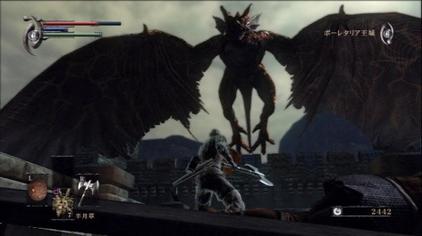
A distinctive World Tendency system shifts each world along a black-to-white axis: dying in human form pushes a world toward black, while defeating a boss pushes it toward white, with each extreme unlocking new enemies, paths, and characters.24 Black tendency makes enemies more aggressive but increases rewards, while white does the opposite, and the overall tendency of every game connected to the network nudges a server-wide tendency, which in turn draws individual games toward the consensus.42 The system was complex enough that players had not fully worked out its implications years after release.4
Online play
The game’s asynchronous online system is often described as its most forward-thinking feature.411 Players connected to the PlayStation Network see the ghosts of others re-enacting their deaths, read and leave messages warning of traps or luring the unwary to their doom, and encounter bloodstains marking where other players fell.116 Living players can be summoned into another’s world as blue phantoms to fight cooperatively, or force their way in as Black Phantoms to assassinate the host for their souls, with no control over when an invasion occurs.411 Some areas, such as the Shrine of Storms, became de facto player-versus-player zones, and one boss, the Old Monk, is fought against another live player summoned to role-play the enemy.11 Critics later called the system one of the greatest in any game, a “literal ghost story” that blended passive and active multiplayer without feeling tacked on.11
Atlus and Sony shut down the North American servers, with a closure originally scheduled for 2012 before being extended.1011 When the closure was finalized, players on the Atlus Faithful mailing list were invited to vote on the World Tendency the game would close upon, with white leading at about 62 percent.10 The definitive shutdown, announced late in 2017 for February the following year, ended the game’s original online functionality with no private servers to replace it.11
Reception and legacy
Critics received Demon’s Souls as a difficult, atmospheric, and visionary work; GameSpot called it “one of the finest games of 2009” and IGN “one of the best on the PlayStation 3”.58 Reviewers likened developing an attachment to the game to a punishing but rewarding relationship, praising its dense, mysterious systems that remained bewildering even after fifty hours of play.34 The game is regarded as a spiritual successor to FromSoftware’s King’s Field series, whose medieval dark-fantasy setting it revived.1524 FromSoftware’s back catalog before it ranged widely — the mecha-focused Armored Core line, the first-person King’s Field and Shadow Tower crawlers, the Echo Night horror adventures, and card-battler Lost Kingdoms.1
It founded FromSoftware’s Souls series and the broader Soulslike genre, and its multiplayer template — cooperative summoning and hostile invasion — carried directly into Dark Souls and Bloodborne.1511 Dark Souls is described as the game’s spiritual successor.224 Over the following decade “soulslike” grew into a recognized sub-genre, and later titles such as Sekiro: Shadows Die Twice, Salt and Sanctuary, Death’s Gambit, and Dead Cells were counted among its descendants.18
A remake developed by Bluepoint Games and published by PlayStation Studios was released as a launch title for the PlayStation 5 on November 12, 2020.1420 Built from the ground up, it added enhanced visuals, a re-recorded orchestral score by Shunsuke Kida performed by a 120-member ensemble with full choir and pipe organ, faster loading from the console’s solid-state drive, omnidirectional rolling in eight directions, expanded six-player online play, a photo mode, a “Fractured Mode” that mirrors the world, and reduced consumable carry limits, while preserving the original’s design.151814 Reviewers praised it as among the best-looking PlayStation 5 launch titles and a faithful modernization of the classic, though some preferred elements of the original’s art direction and soundtrack.1420
Sources
IGN article tracing From Software's history from office software company through King's Field and multiple PlayStation RPGs before Demon's Souls.
ign.com · retrieved Jul 4, 2026VG247 news report on Atlus allowing Demon's Souls players to vote on final World Tendency setting before US servers shutdown in 2012.
vg247.com · retrieved Jul 4, 2026Eurogamer's import review of Demon's Souls describing it as a brutal, bleak action RPG with unique network play mechanics and World Tendency system.
web.archive.org · retrieved Jul 4, 2026Eurogamer review detailing Demon's Souls' challenging combat, online invasion mechanics, and complex World Tendency system affecting difficulty and level design.
eurogamer.net · retrieved Jul 4, 2026GameSpot review praising Demon's Souls as brutally challenging, innovative action-RPG with unforgiving game design that refuses to coddle players.
web.archive.org · retrieved Jul 4, 2026PlayStation Blog post announcing Demon's Souls US release with beginner tips on character creation and class selection for new players.
blog.us.playstation.com · retrieved Jul 4, 2026Edge Online interview with Hidetaka Miyazaki and Takeshi Kajii discussing Demon's Souls' design philosophy and its departure from typical JRPG conventions.
web.archive.org · retrieved Jul 4, 2026IGN review of Demon's Souls praising its risk-reward mechanics, permanent consequences, and unpaused combat that recaptures old-school gaming difficulty.
web.archive.org · retrieved Jul 4, 2026Archived VG247 article on Demon's Souls players voting for final World Tendency before 2012 US server shutdown.
web.archive.org · retrieved Jul 4, 2026USGamer analysis of Demon's Souls' pioneering online system blending passive and active multiplayer through ghosts, messages, and invasions as ghost story experience.
web.archive.org · retrieved Jul 4, 2026Game Informer review of Bluepoint Games' PS5 remake praising its faithfulness to original while adding performance enhancements and quality-of-life improvements.
gameinformer.com · retrieved Jul 4, 2026Fextralife wiki guide offering comprehensive Demon's Souls information including weapons, classes, bosses, lore, and details on the PS5 remake changes.
demonssouls.wiki.fextralife.com · retrieved Jul 4, 2026PlayStation official store page describing Demon's Souls remake as entirely rebuilt action-RPG with brutal combat, dark fantasy setting, and PvP multiplayer.
playstation.com · retrieved Jul 4, 2026GeeksUnderGrace review of PS5 remake examining gameplay, story delivery through abstraction, and updated presentation of the original PlayStation classic.
geeksundergrace.com · retrieved Jul 4, 2026ForeverClassicGames review praising Bluepoint's PS5 remake for smooth gameplay, enhanced visuals, audio, and quality-of-life improvements over PS3 original.
foreverclassicgames.com · retrieved Jul 4, 2026GameFAQs forum post noting King's Field as inspiration for Demon's Souls which itself inspired Dark Souls series.
gamefaqs.gamespot.com · retrieved Jul 4, 2026